Why the Arecibo message used 1,679 bits
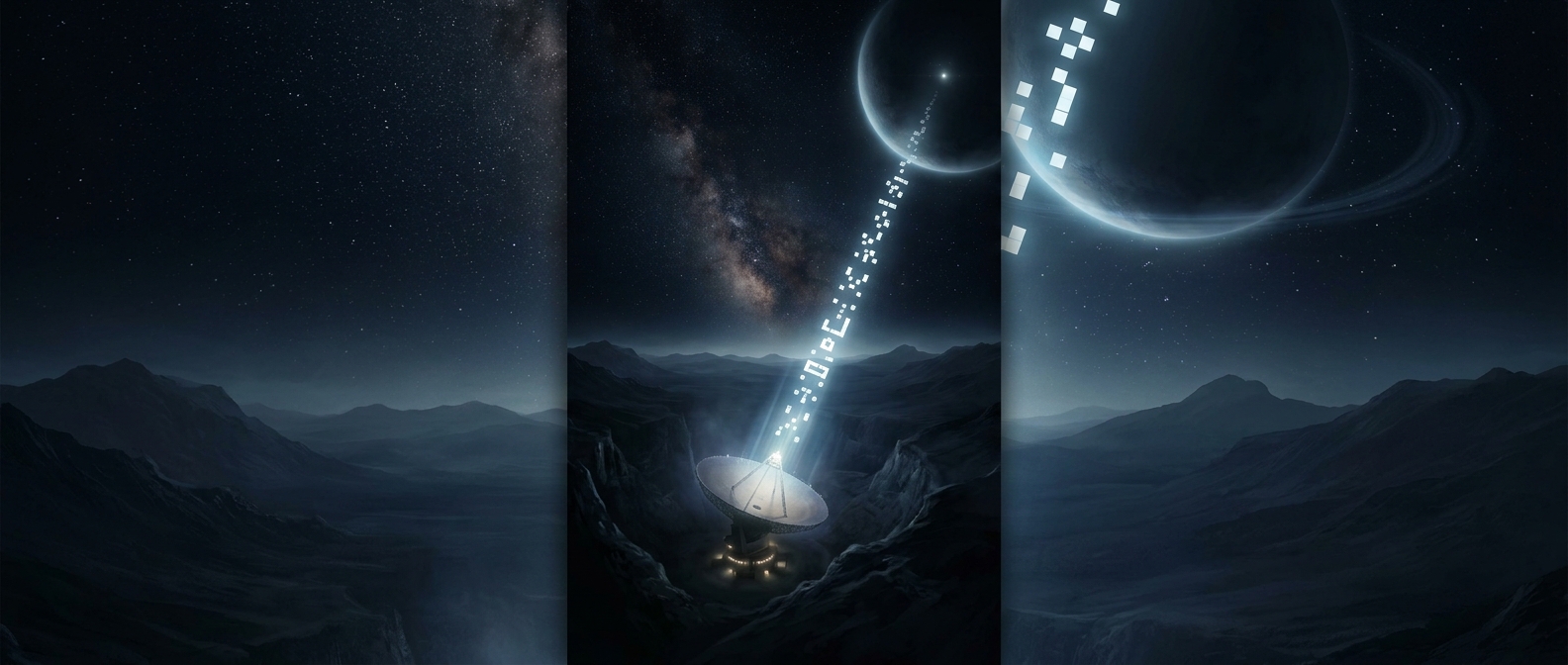
In 1974, scientists used the Arecibo radio telescope in Puerto Rico to send a brief, deliberately structured burst of radio waves toward the globular star cluster M13. The message’s 1,679 bits—binary digits, each represented by one of two signal states—were chosen to form a rectangle: 23 columns by 73 rows. Both numbers are prime, making that arrangement a clue to how the sequence should be laid out.
Read in the intended pattern, the bits become a crude pixel picture. It is less like a sentence than a page of diagrams: it presents mathematical numbers, the atomic ingredients of life, parts of DNA’s chemical structure, a human figure, and information about Earth and the transmitting telescope. The design assumes that a recipient could recognize basic numerical patterns and infer how to turn the sequence into an image.
A demonstration, not a conversation
The message was a proof of concept: it showed that a powerful radio telescope could transmit organized information across space. It was not a realistic exchange with M13. The cluster is about 25,000 light-years away, so even if a receiver there detected the signal and replied immediately, the answer could not reach Earth for roughly 50,000 years. And the signal spreads and weakens as it travels, making detection depend on a suitably capable receiver being in its path.
That delay is part of what makes the message striking. Its entire visual argument fits into a few thousand bits, but any response would belong to a timescale far beyond a human conversation.