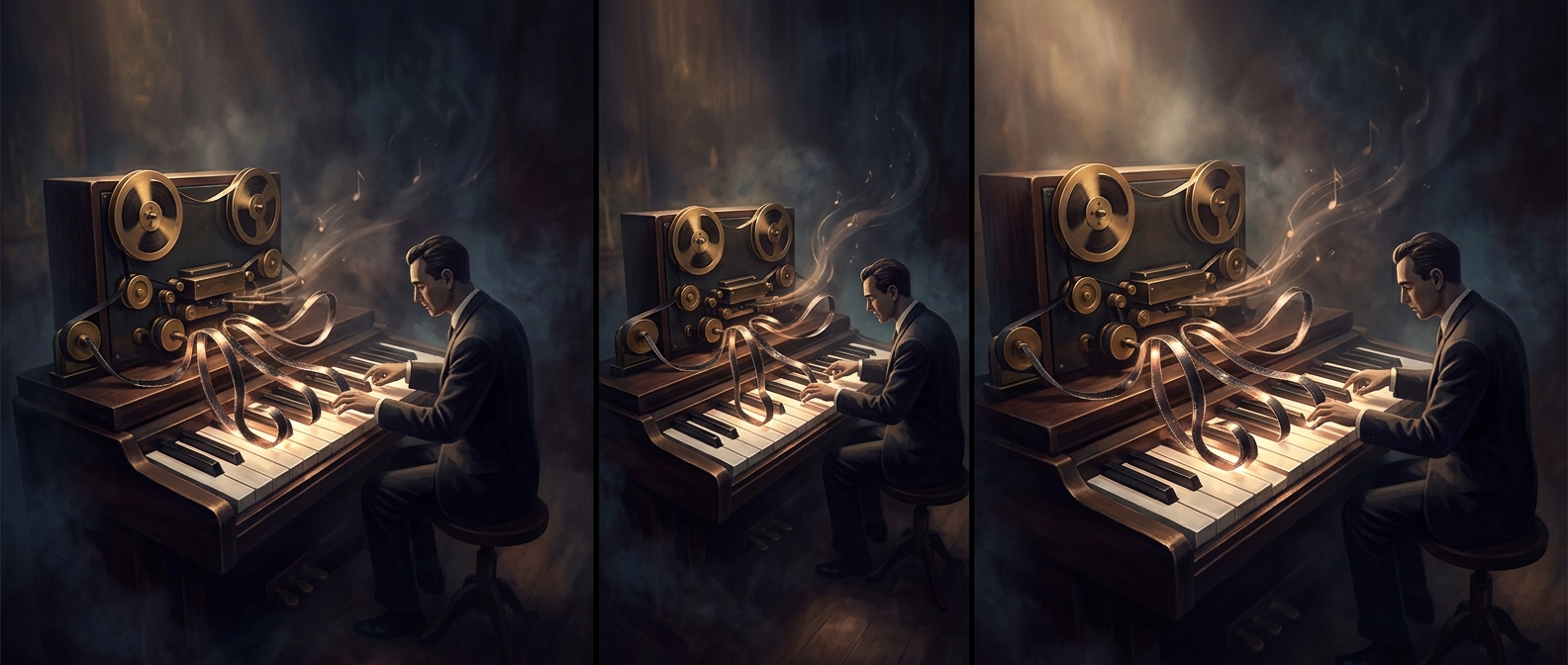
Turning recorded sound into an instrument
A piano key normally sets a string vibrating. On Pierre Schaeffer’s Phonogene, a key instead set a recorded sound in motion. The sound was captured on magnetic tape, cut into a loop, and played back when selected. That made a whistle, clatter, or fragment of city noise something a performer could summon in musical time—not just hear once in a recording.
The keyboard also changed playback speed. Faster tape produces a higher, shorter sound; slower tape lowers and stretches it. So a train whistle could be reshaped into a different pitch and duration without a conventional musical instrument ever making the original tone.
The limits were part of the instrument
Tape loops had to travel through moving mechanical parts, and a jam could interrupt the sound altogether. The Phonogene was bulky and unreliable by the standards of a keyboard instrument, but its basic idea was striking: recorded sounds could be organized, repeated, and played as notes.
That approach helped open a path toward sampling, in which musicians trigger recorded audio rather than generate every sound from scratch. The difference is that a modern sampler can usually store and repeat sounds electronically; Schaeffer’s machine made the recording itself move through the instrument, with all the friction—and possibility—that entailed.