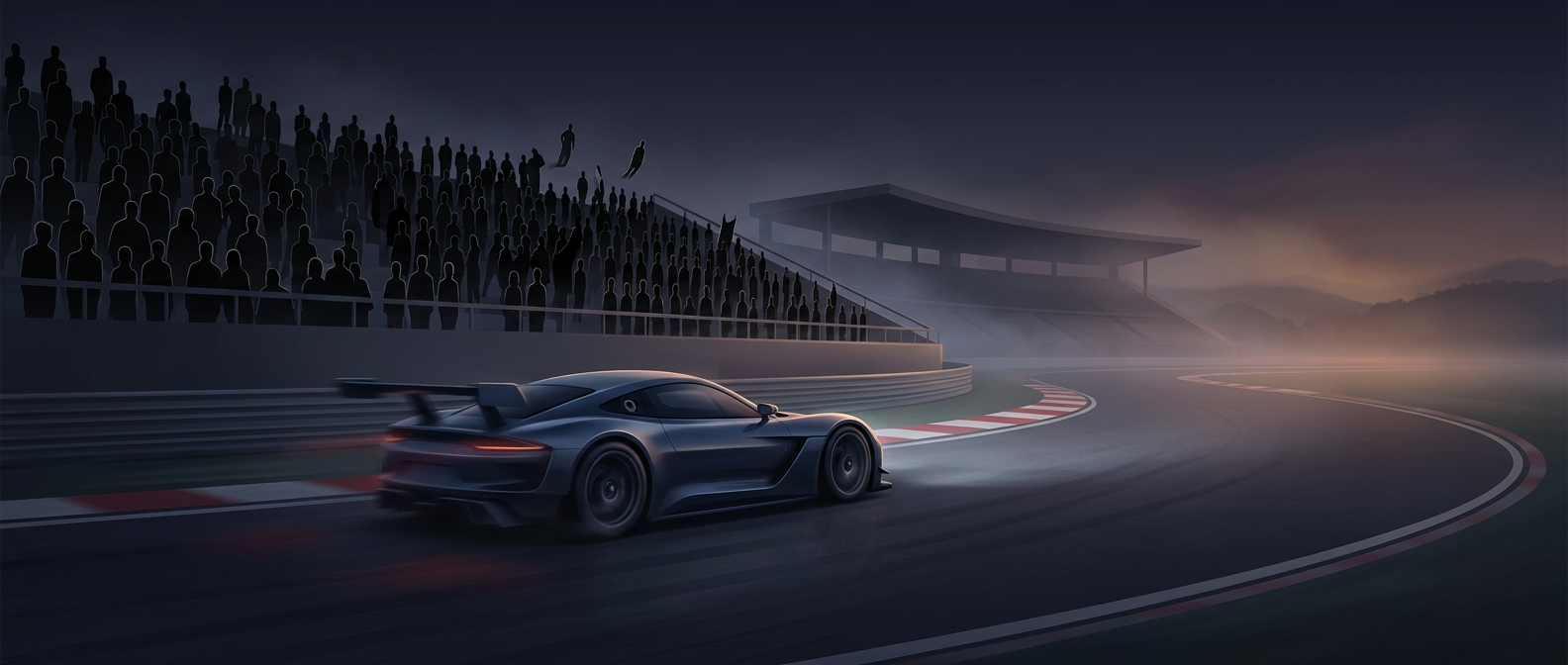
Why the crowd looks like a cutout
A racing game has to draw the track, cars, scenery, and spectators many times every second. A fully modeled person—with depth, clothing, and movement—costs more to render than a flat image. So crowds can be represented as 2D figures placed in a 3D scene, a technique often called a billboard: the picture is angled toward the player so it reads as a person from the road.
At racing speed, that shortcut is hard to notice. Spectators usually sit behind barriers and flash past at the edge of the view. They supply the impression of a packed event without demanding the same computing work as objects the player watches closely.
Why the cars get the detail
The car occupies the center of attention. Players see it from nearby, track its shape through turns, and often choose or customize it. Reflections help make its paint and bodywork feel solid as the camera moves, so detailed surfaces have a visible payoff that extra detail on distant spectators may not.
That is a deliberate allocation of limited rendering resources, not an attempt to make every object equally realistic. The game spends detail where players are most likely to look—and where that detail changes how the scene feels. The result is a striking contrast: a reflective machine in the foreground, backed by a crowd that can resemble a row of cardboard fans.