Turning a moving aircraft into a firing solution
A bomb released from a plane does not fall straight down onto the point beneath it. It keeps moving forward, while wind can push it sideways. The Norden bombsight was built to estimate where the aircraft should release its bombs so they would reach the target after that journey.
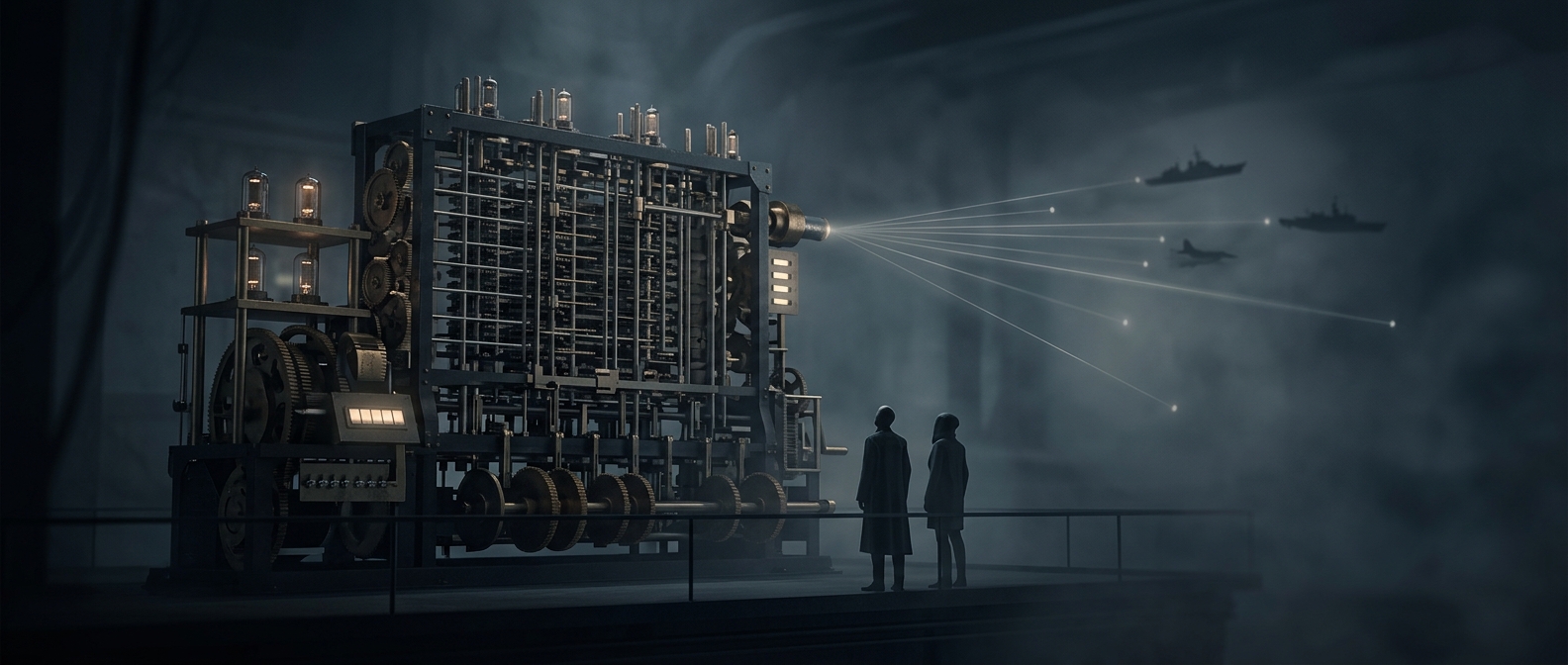
Its operator supplied flight information such as altitude and airspeed. Inside the sight, gears and gyroscopes—a spinning device that helps detect and resist changes in direction—combined those inputs into a calculated aiming point. The bombardier then adjusted the sight as the target moved through view. In principle, the instrument could tell the crew when to drop rather than relying on a rough visual guess.
Why the calculation could fail in combat
The machine’s answer was only as useful as its inputs and the conditions around it. Wind estimates could be wrong; the aircraft’s speed or altitude could change; and turbulence could shake the plane during the approach. The bombardier also needed to see the target clearly enough to keep tracking it. Clouds, smoke, darkness, evasive maneuvers, and enemy fire could disrupt that sequence.
A gyroscope could steady the sight’s reference, but it could not steady the whole aircraft or make a hidden target visible. Nor could the mechanism remove uncertainty from the wind or guarantee that the bombs would behave exactly as predicted after release.
Precision depended on the whole mission
The Norden embodied a powerful idea: replace some of the bombardier’s split-second judgment with a repeatable mechanical calculation. But the calculation did not operate in isolation. Crews had to reach the target, hold a suitable course, gather usable information, and see the aiming point long enough to act.
That is the gap between a precise instrument and a precise outcome. In combat, the bombsight could improve the decision about when to release; it could not ensure that conditions would let the crew make that decision well.