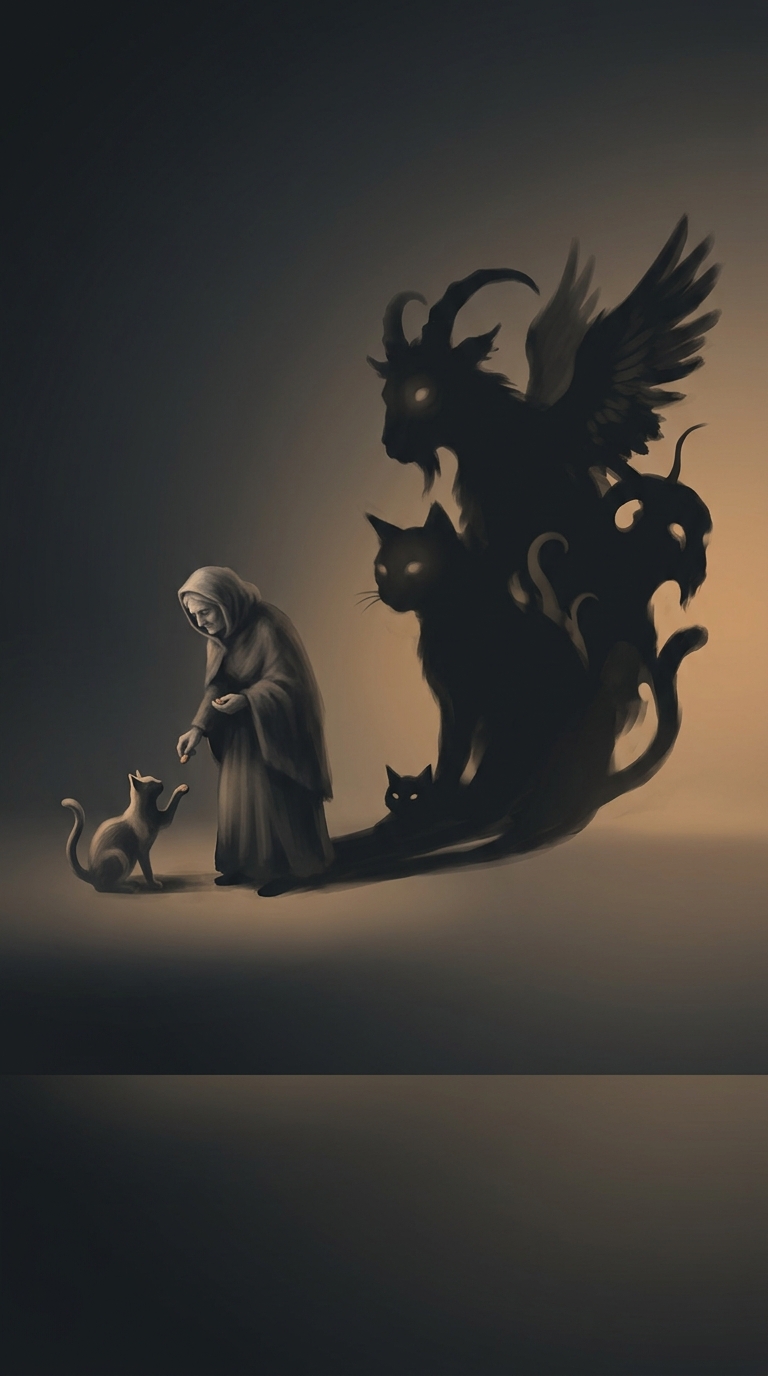
How an ordinary animal became suspicious
In early modern witch trials, a familiar was understood to be a spirit that served a witch, often appearing in animal form. The word did not simply mean a pet. Believers thought the animal might carry out small acts of harm or help its supposed owner maintain a relationship with the devil. Cats and dogs could attract suspicion, but accounts also described other animals.
That belief made ordinary behavior seem incriminating. A woman who fed an animal, spoke to it, or kept it close could be interpreted as giving a familiar attention or sustenance. Some accounts described a familiar supposedly drinking blood from a mark on the accused person’s body. Such interpretations turned everyday details into signs within a larger religious story about hidden allegiance to the devil.
Suspicion became evidence through interpretation
Accusations did not arise from pet ownership alone. In European and American trials, neighbors’ conflicts, local fears, and suspicions of harmful magic could all shape who was accused. The familiar provided a way to explain that suspicion: an animal or a gesture toward it could be presented as proof of an invisible pact.
But calling something evidence did not make it reliable proof by modern standards. What counted was filtered through the assumptions of the court and community. A familiar claim might reinforce other accusations, while a person’s ordinary care for an animal could be recast as evidence of illicit service. The danger lay in how readily a belief supplied a guilty meaning for an ambiguous act.
The human cost of a supernatural explanation
Witchcraft prosecutions were not confined to the Middle Ages; many of the best-known European and colonial American trials took place in the early modern period. Their outcomes varied, and no single explanation accounts for every accusation or execution. Yet familiar beliefs helped make prosecution seem coherent to people who accepted a world in which the devil could act through human agents.
The same small scene—someone setting out scraps for an animal—could therefore be understood in two radically different ways. In one, it was care; in the other, it was a clue to a hidden conspiracy. When courts treated that second interpretation as credible, an ordinary bond with an animal could become part of a case with life-or-death consequences.