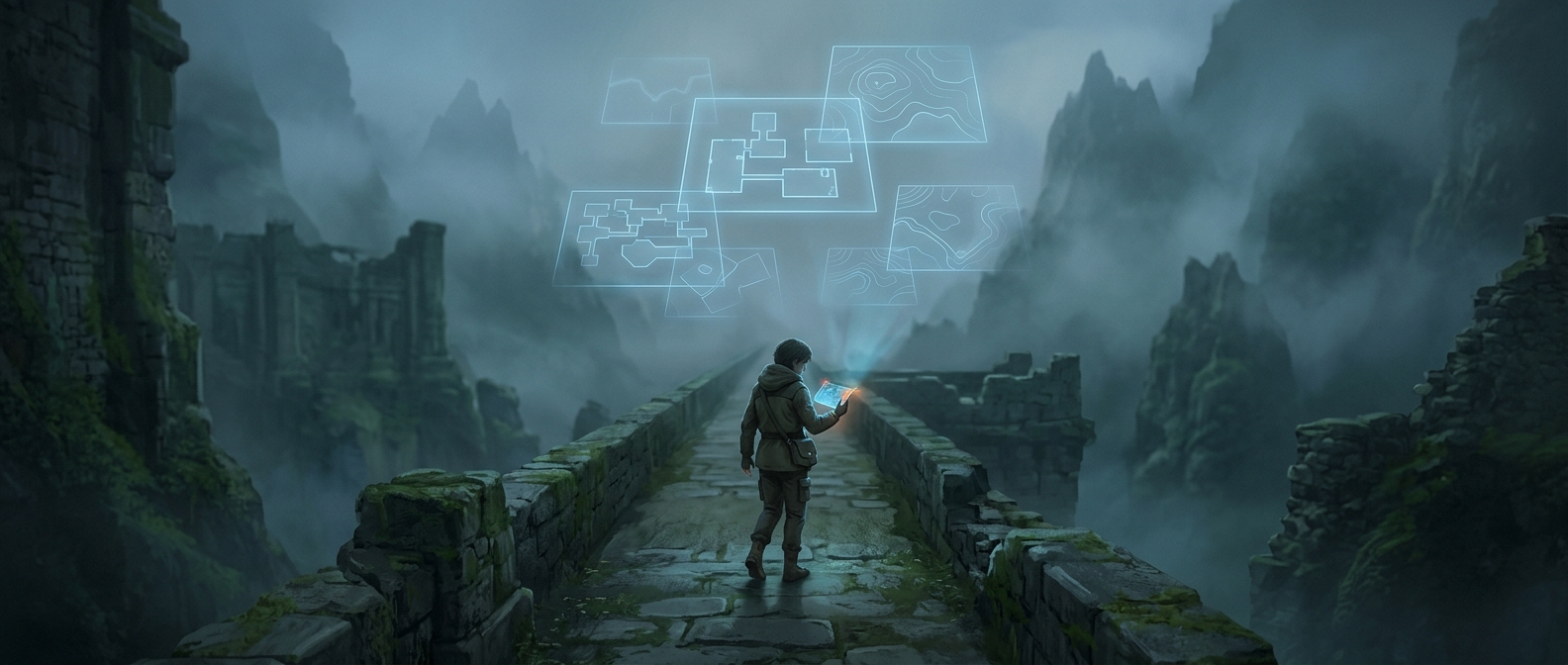
A straight road can still leave room for doubt
In a navigation game, following a road and knowing your direction are different tasks. The road tells you where you can travel; the compass tells you how the game’s world is oriented. A player can stay on a clear northbound route and still wonder whether “north” on the screen matches north in the world.
That uncertainty grows when the map and the view use different frames. A map may stay fixed with north at the top, while the player’s view turns with the character. If the camera rotates, the landscape looks different even though the route has not changed. Checking the map is a quick way to reconnect the road ahead with the larger layout.
The check is part of the design
Games often make orientation a small, repeated decision rather than a one-time lesson. Players glance at the map to confirm their heading, spot a turn coming up, or make sure they have not drifted onto a parallel path. On a straight stretch, the check may seem unnecessary—but it costs little and prevents a larger mistake later.
This is especially useful when landmarks are sparse or roads look alike. A familiar compass direction becomes a reference point: if the player expects to be heading north, the map can reassure them that the world has not rotated or that they have not taken an unnoticed bend. The road keeps the character moving; the map keeps the player oriented.