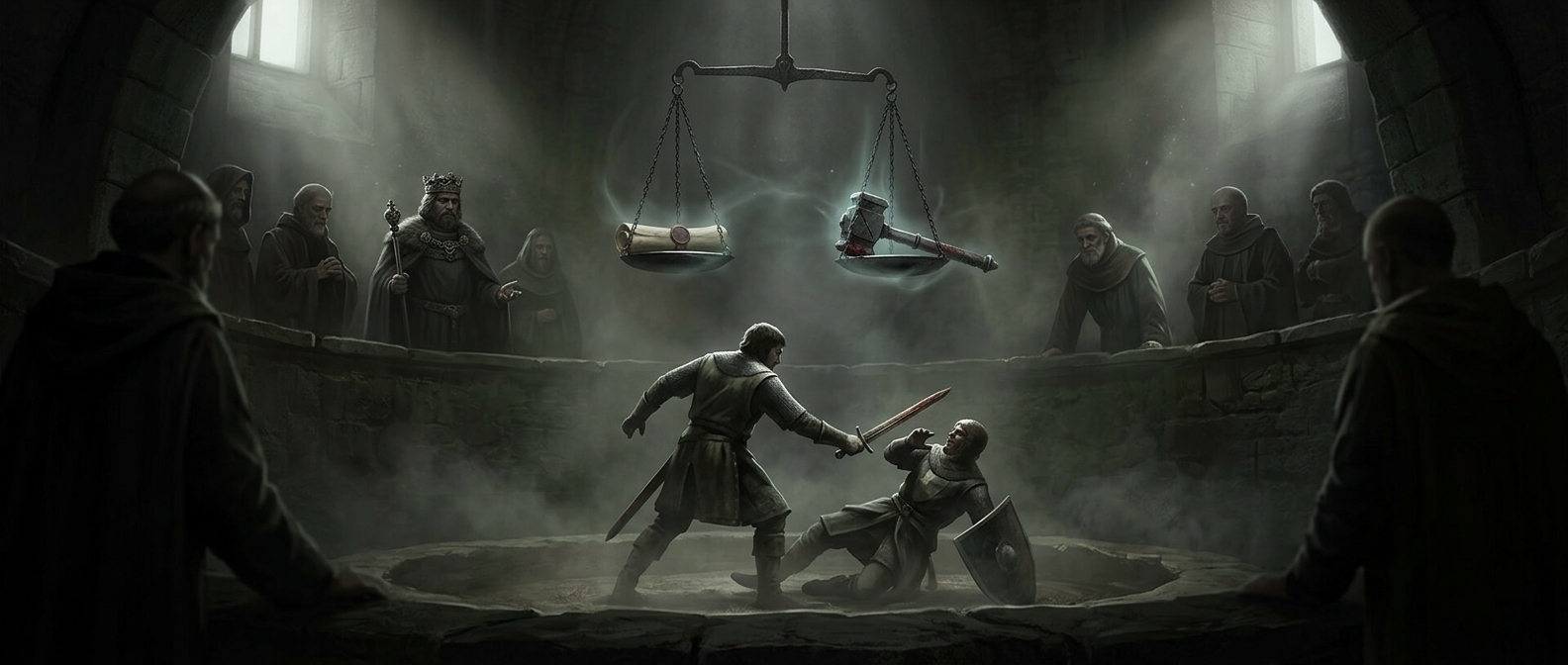
A fight could stand in for missing evidence
Judicial combat—often called trial by battle—was a way to resolve certain disputes when ordinary proof seemed unavailable or insufficient. One person made a formal claim; the other denied it. Rather than ask a jury to decide whose account was true, a court could authorize a contest whose result counted as the legal answer.
The reasoning rested on a religious premise: God would allow the rightful party to prevail. That did not mean every medieval court case ended in a duel. The practice varied by place and period, and it applied only to particular kinds of claims. It was a recognized procedure, not permission for rivals to settle any quarrel with weapons.
The contest had legal consequences
A judicial battle was governed by rules set for the case, including the place and conditions of the fight. The parties might fight themselves, or a representative could sometimes take a party’s place. The winner did not merely gain bragging rights: victory could settle the claim, while defeat could bring serious penalties, depending on the case and local law.
That made the procedure a stark alternative to testimony and evidence. It turned a dispute about events—who owed what, or who had committed a wrong—into a contest whose outcome the court treated as decisive. The ritual gave the judgment a religious meaning, but its practical effect was unmistakably legal: a bodily victory could determine property, liability, or punishment.