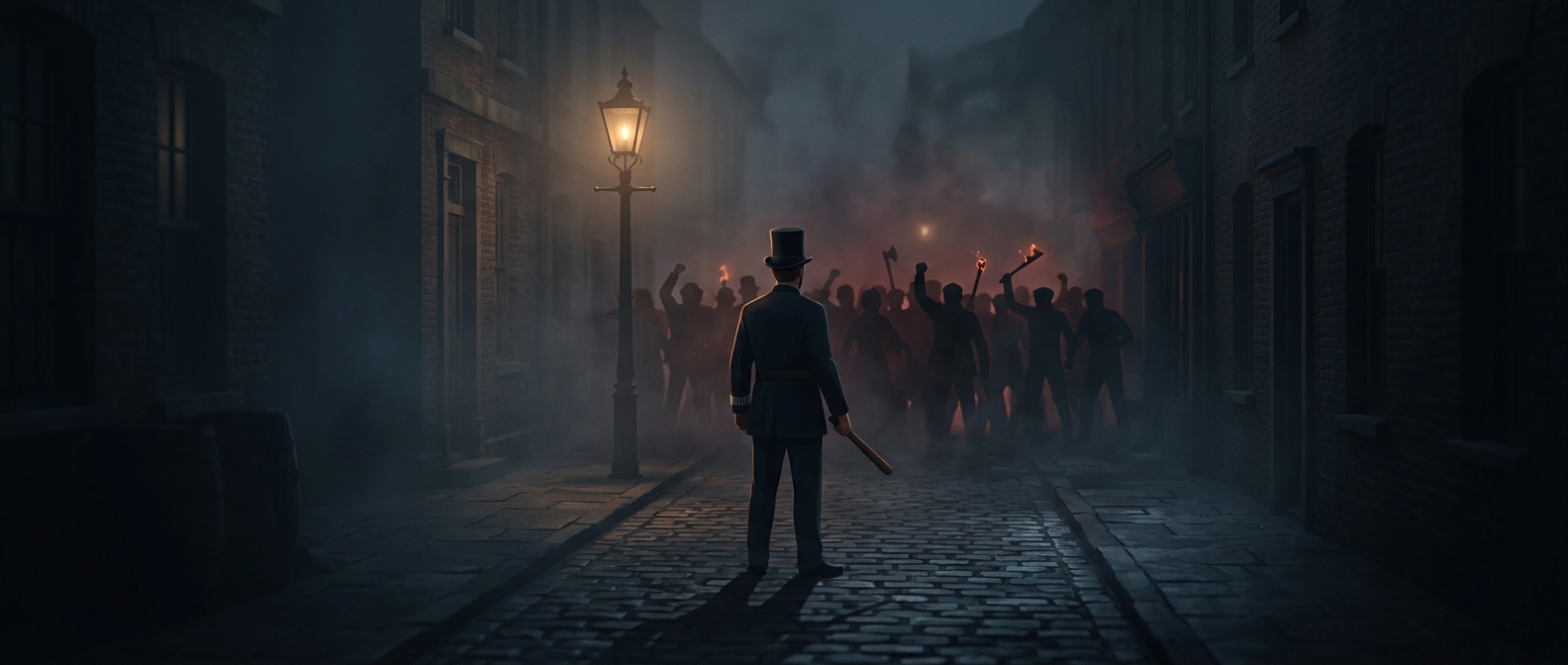
A new force in the streets
Before 1829, London relied on a patchwork of parish watchmen, constables and specialist Bow Street officers. Robert Peel’s Metropolitan Police replaced much of that fragmented system with a paid, centrally organized force that patrolled streets routinely. To supporters, regular patrols promised to deter crime. To wary Londoners, they also meant a new government presence in everyday life.
The concern was political as well as practical. Britain had recently seen authorities use force against public protest, and memories of events such as the Peterloo massacre remained fresh. A police force directed from the center might, critics feared, monitor meetings, intimidate opponents or enforce unpopular government decisions. Its blue uniforms made officers conspicuous; they were not merely anonymous neighbors but agents of a new institution.
Prevention—and the fear of control
Peel’s model emphasized preventing crime by having officers patrol before trouble occurred, rather than relying only on arrests after the fact. That approach required police to observe public spaces and intervene when they judged it necessary. The same visibility that might reassure residents could look like surveillance, especially to people who distrusted the government or expected police to suppress dissent.
The new force also challenged local habits and authority. Parish-based policing was inconsistent, but it was familiar and tied to local communities. A professional force answering through central government raised a sharper question: who would control the people empowered to question, stop or arrest Londoners?
Trust had to be earned
The Metropolitan Police did not win universal approval simply by appearing in uniform. Officers had to show, through everyday conduct, that their role was public safety rather than political repression. Their presence gradually became an ordinary feature of city life, though the underlying tension never vanished: policing can protect people from crime while also giving the state power over public space.
That is why the early resistance mattered. Londoners were not only judging a new way to catch criminals; they were testing how much authority a government should be allowed to place on every street corner.