Why a Keyboard Smash Reads Like a Reaction
A string such as “asdfghjkl” looks meaningless by design. Its message comes from the contrast: the writer has sent a burst of text, but not a sentence. In a fast-moving chat, that can signal that a reaction is too intense, sudden, or tangled to shape into ordinary words.
The keyboard itself helps make the gesture recognizable. Nearby keys are easy to hit in a rush, so the result often looks like a dense jumble rather than a deliberate word. Readers generally do not decode the characters; they infer the writer’s state from the act of sending them. It can stand in for laughter, excitement, shock, frustration, or embarrassment—the surrounding conversation supplies the clue.
A Tiny Performance of Losing Composure
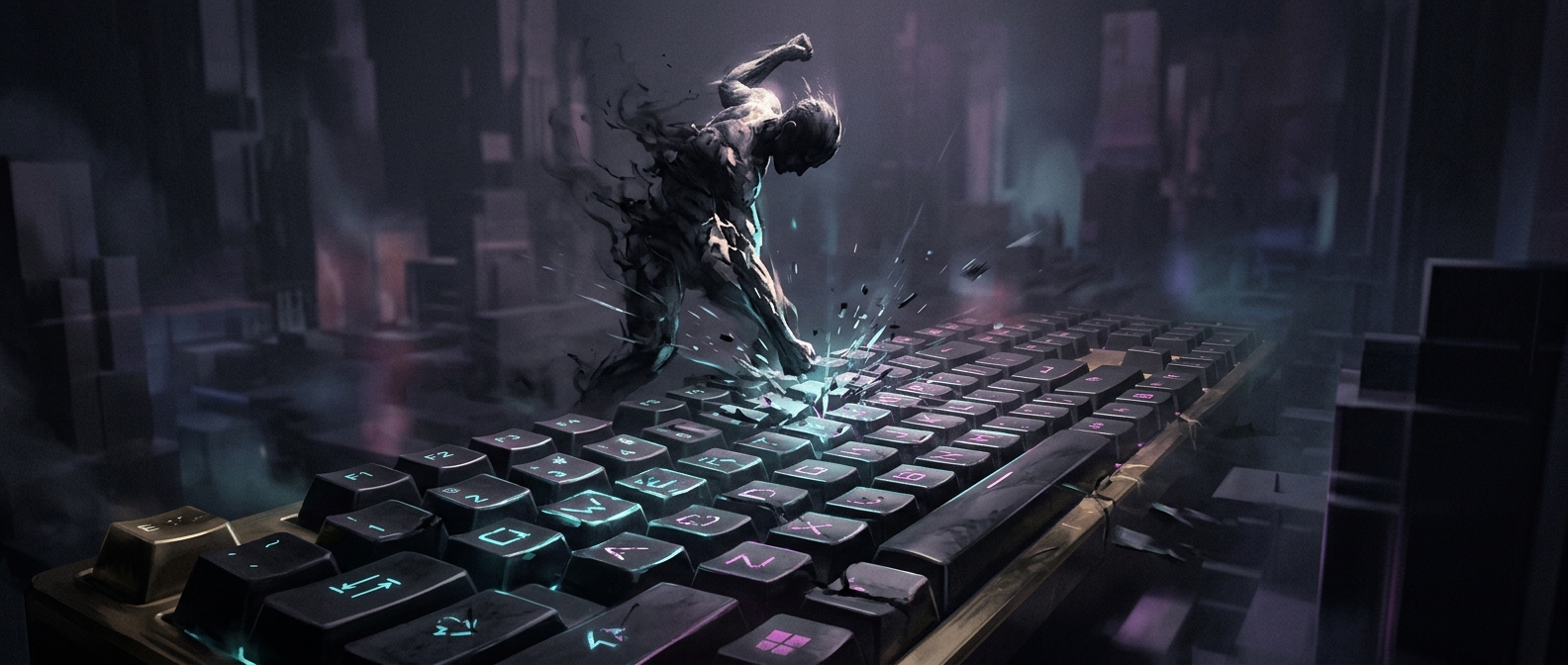
A keyboard smash is more than a failed attempt to type. It presents a small scene: feeling has overflowed the writer’s usual control of language. That makes it useful where a plain “wow” or “I’m upset” would feel too measured. A longer jumble can look more emphatic, while a short one can serve as a quick, playful reaction, though the exact meaning depends on the people and context.
Because the characters are not fixed to one emotion, the same smash can express delight in one conversation and exasperation in another. It works less like a word with a dictionary definition and more like a typed gesture—closer to a gasp or an emphatic burst of laughter than to a sentence. Its apparent randomness is precisely what lets it convey a reaction that the writer has not, or cannot, put into words.