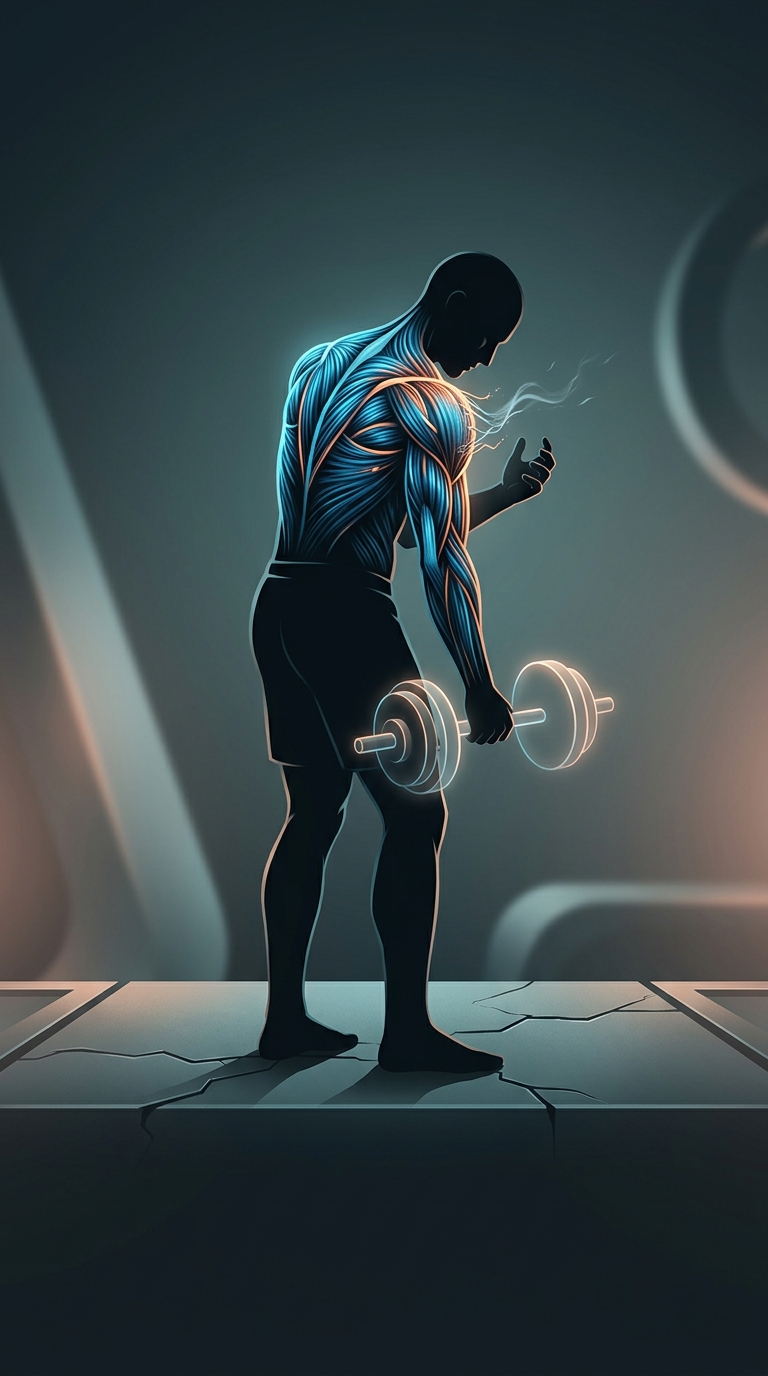
Why explosive muscle power fades
A muscle does not run directly on oxygen or food in the moment. Its fibers contract using ATP, a molecule that serves as the cell’s immediate energy currency. Because muscle stores only a little ATP, it must constantly rebuild the supply. During a sprint or heavy lift, fast-twitch fibers use ATP so quickly that the body cannot replace it at the same pace.
One rapid backup is phosphocreatine, a stored compound that helps remake ATP. It can support very intense effort, but its supply is limited. As it falls, the muscle has to rely more on slower energy-producing pathways, which cannot sustain the same peak power. That is why a maximal effort is often a brief burst rather than a steady output.
Fatigue is more than an empty tank
The muscle is not simply out of fuel. As intense contractions continue, chemical changes inside the muscle make it harder for the fibers to produce force, while the nervous system may also reduce its drive to them. The result is a drop in speed or strength—even if the person is still trying hard.
During rest, the body restores phosphocreatine and rebalances the muscle’s chemistry. A short pause can bring back some explosive capacity, but full recovery takes longer, especially after repeated maximal efforts. The interval needed depends on the effort and the person; there is no single countdown that applies to every sprint or lift.
This is why explosive training is commonly organized as brief, hard bouts with recovery between them. If the next repetition starts before power returns, it may still build work capacity, but it is no longer the same fresh, all-out burst.