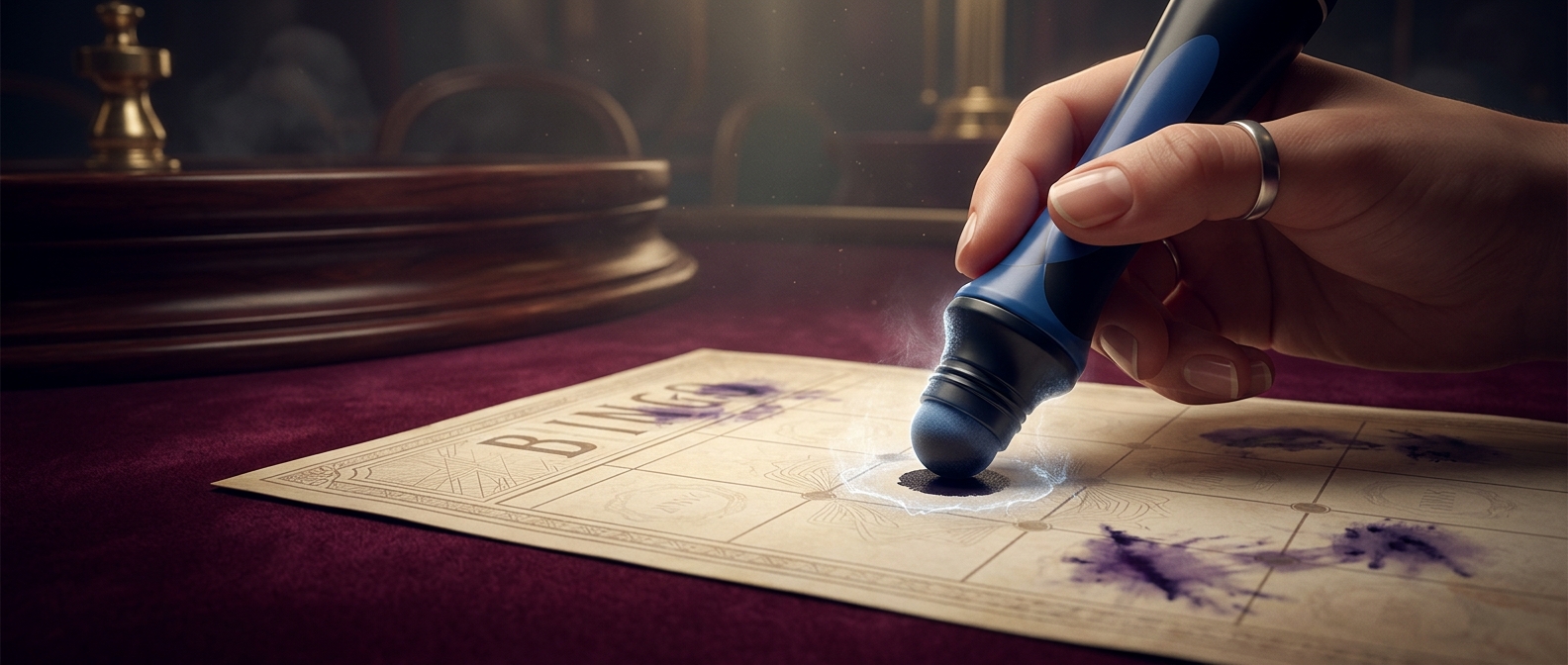
Why Bingo Ink Sets So Quickly
A bingo dauber has a broad, felt-like tip that lays down a generous mark in one press. That makes speed important: players may mark several called numbers in quick succession, often with a hand moving across the card. Ink that stays wet would be easy to drag into a streak or transfer to a neighboring square.
The quick-drying effect comes from the ink and the paper working together. Dauber ink is formulated to set rapidly, while the card’s absorbent surface draws liquid into its fibers. As the liquid portion leaves the surface, the colored mark is less likely to smear when a hand brushes over it.
A Tradeoff Between Boldness and Cleanliness
Bingo ink must be visible enough to cover a number, but a mark should not spread so much that it obscures nearby spaces. The dauber’s tip helps place a compact blot; the fast-setting ink helps keep that blot where it lands. Together, they make marking a card quick without requiring players to wait after every number.
“Almost immediately” does not mean the ink cannot smear under any conditions: pressing hard, using a card with a different surface, or rubbing a fresh mark can still disturb it. But on ordinary bingo paper, the short drying time lets the next call arrive before the last mark has much chance to travel.