A royal name in a sky full of gods
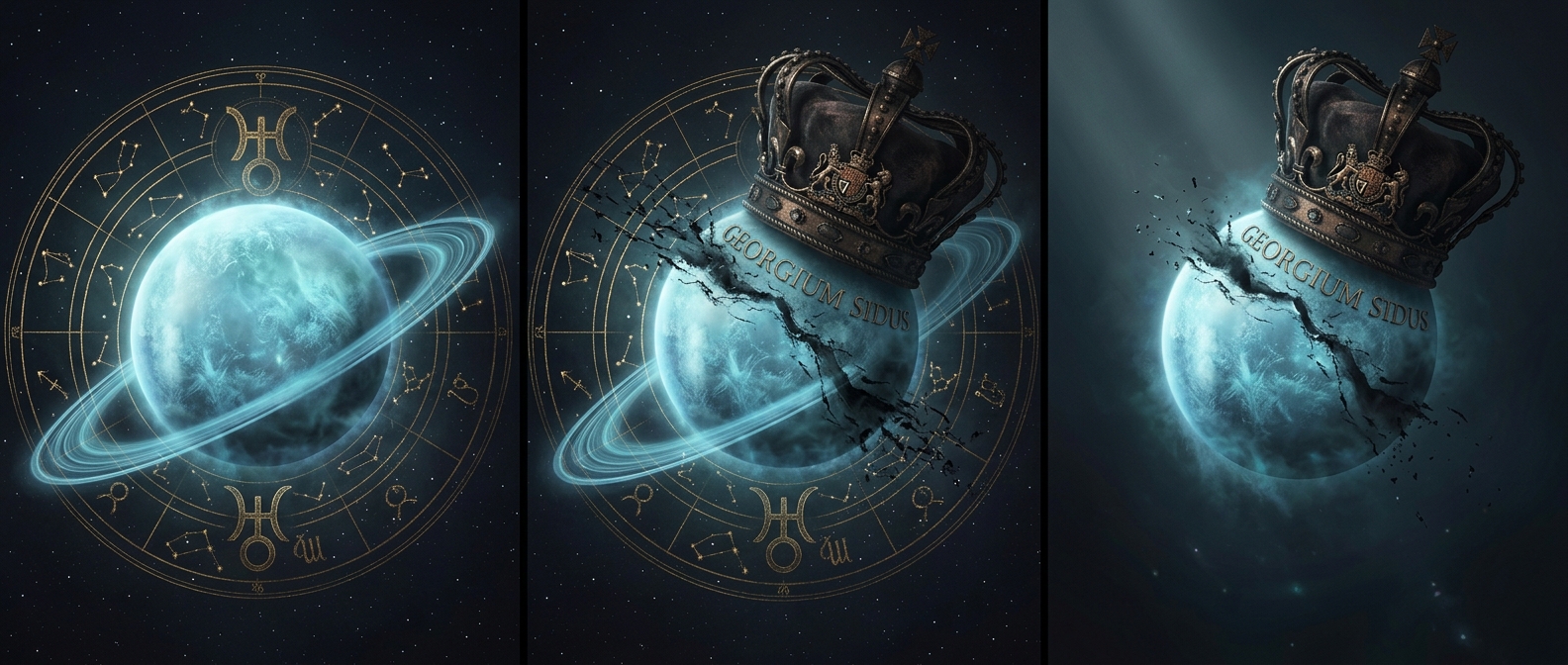
When William Herschel announced his 1781 discovery, he proposed Georgium Sidus—Latin for “George’s Star”—in honor of King George III. The choice was more than a personal compliment: naming a newly discovered planet for the reigning monarch could tie the discovery to British prestige. But it also broke the pattern that made the familiar planetary names feel like a set.
Most planets visible to ancient observers carried the names of Roman gods. A new royal name would have made the solar system’s naming scheme less mythological and more political—and, in Britain’s case, national.
Why Uranus won
German astronomer Johann Elert Bode argued for Uranus, invoking the Greek sky god who was the father of Saturn in mythology. That preserved a family-like sequence among the planets: Saturn was associated with Jupiter, and Uranus’s place before Saturn in the mythic generations matched its position farther from the Sun. The name also fit the established habit of drawing planetary names from classical mythology.
The change did not happen everywhere at once. Herschel’s royal name remained in use in Britain for years, while astronomers elsewhere favored alternatives, including “Herschel.” Uranus gradually became the common international choice as astronomers and almanacs settled on a shared name.
A name changes the chart, not the sky
Astrology charts depend on labels as well as positions: a chart using “Georgium Sidus” would identify the same distant world that later charts call Uranus. Astrologers built interpretations around the adopted name and its mythological associations, so a royal name would have offered a very different symbolic starting point. The planet’s orbit would not have changed—but the word generations of readers learned to attach to it might have.