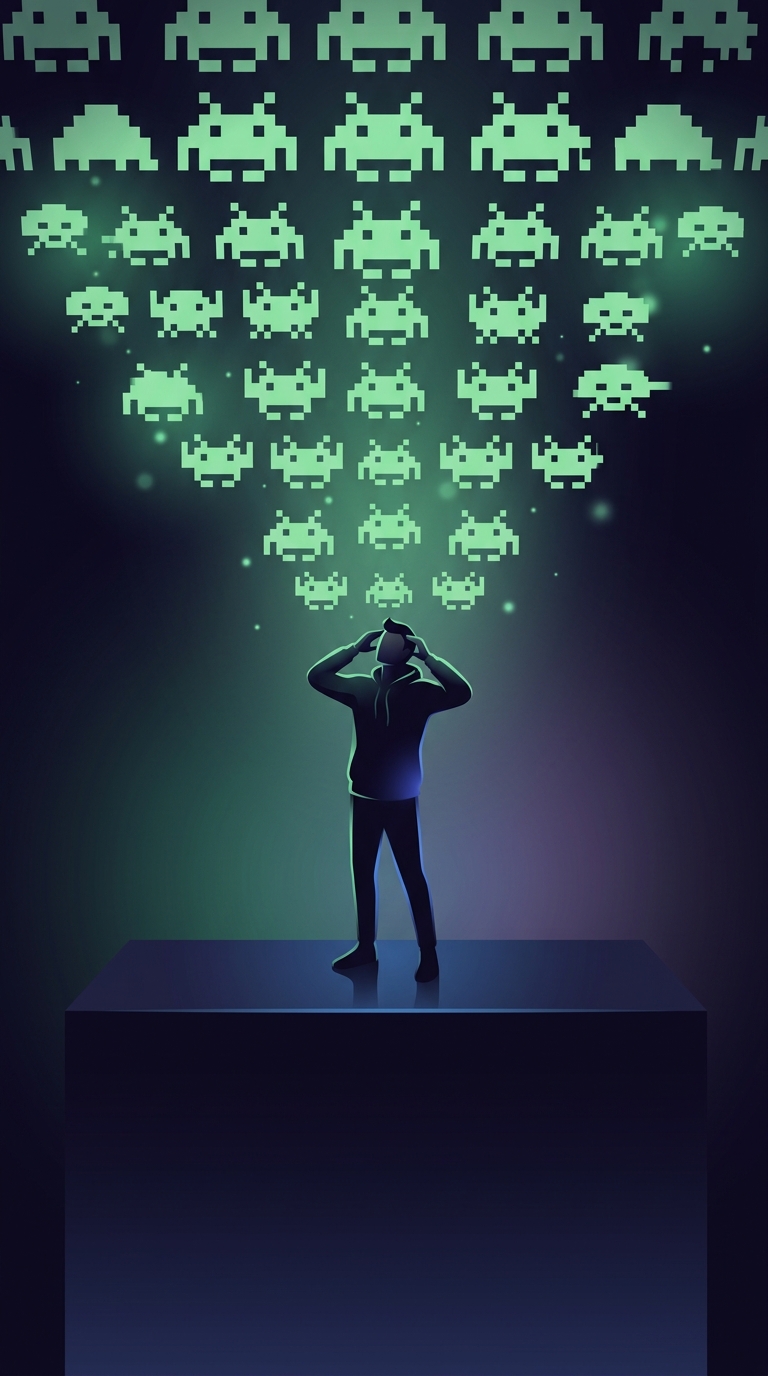
A hardware limit became the game’s signature
In Space Invaders, the alien formation speeds up as the player destroys it. That escalation was not simply a difficulty setting chosen to make later moments tougher. It grew out of the limits of the arcade machine running the game.
The cabinet’s processor had to keep track of the invaders and update their positions. With a full formation, that took more work; after the player removed aliens, there was less to process, and the remaining group could move faster. The result was an unusual inversion: success made the immediate threat more nimble.
The rhythm turns progress into pressure
The fleet’s steady sideways march, its reversal at the edge of the screen, and the tightening pace make its approach easy to read. But every hit changes the rhythm. A formation that once advanced in measured steps starts darting across the screen, while the survivors continue toward the bottom. The player has fewer targets to handle, yet less time to handle them.
That mechanical quirk helped create the game’s distinctive panic: clearing the screen did not make the danger fade; it made the last invaders rush. What began as a consequence of limited computing power became a memorable part of the challenge.