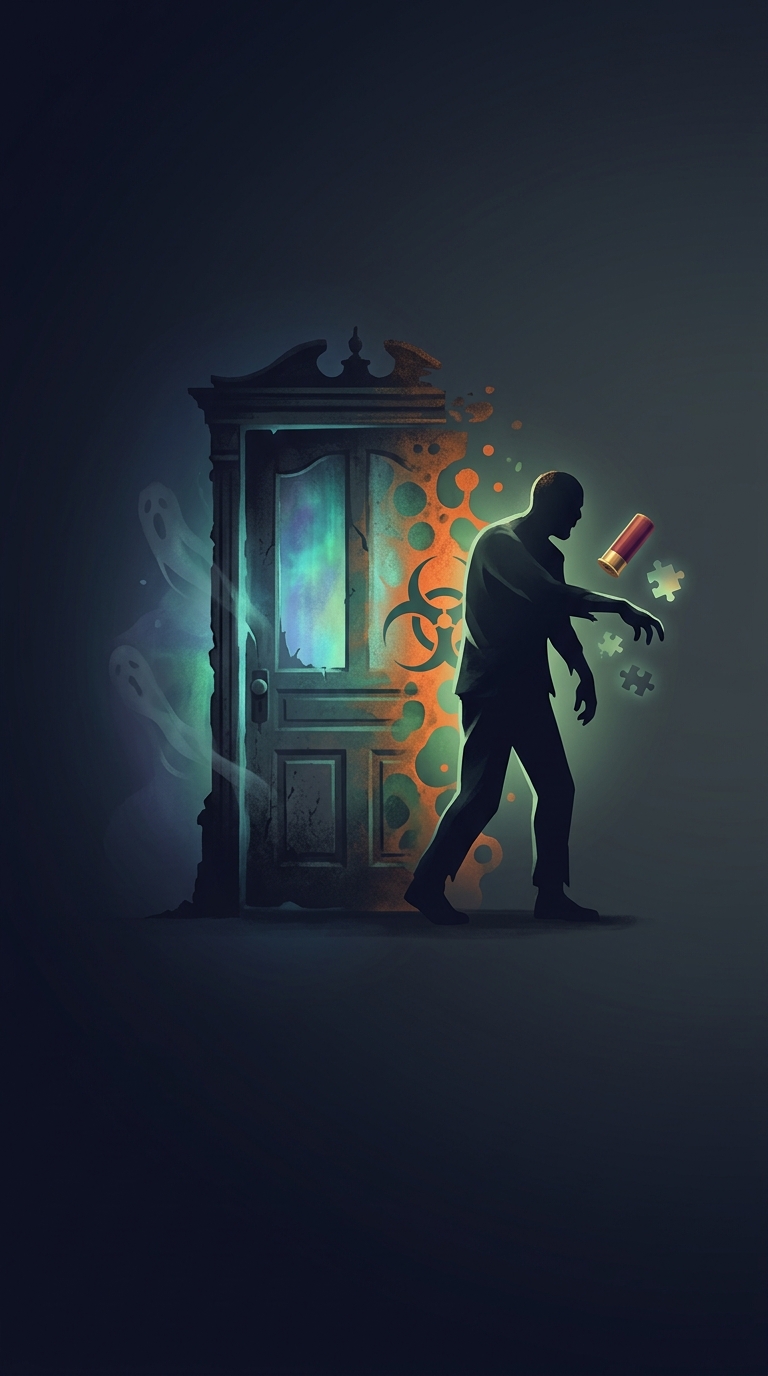
A remake outgrew its source
When Capcom began work on what became Resident Evil, the project was tied to Sweet Home, a 1989 Japanese game set in a haunted mansion. Its supernatural premise supplied a useful starting point, but the team was not simply translating the older game into newer graphics. As development took shape, the remake concept gave way to a new story and cast, while the mansion setting and puzzle-driven exploration remained valuable foundations.
That shift mattered because Sweet Home already treated survival as more than fighting monsters. Players had to manage a group of characters, make choices about what to carry, and solve environmental puzzles. Resident Evil reshaped that kind of pressure around a smaller, more immediate experience: a few characters exploring a dangerous house with scarce ammunition and limited room for supplies.
Why zombies changed the feel
Replacing ghosts with zombies changed the threat from a haunting to a physical emergency. A ghost suggests an unseen, possibly supernatural danger; a zombie can block a hallway, attack at close range, and force the player to decide whether to spend ammunition or try to get past. The outbreak also gave the story a clear chain of danger: infected people turn into attackers, and the mansion becomes a place to contain and survive that crisis.
The game’s presentation reinforced the same tension. Fixed camera angles—views that stay in predetermined positions rather than following the character—could hide what waited around a corner. That made movement through the house feel uncertain, while scarce supplies made every encounter a calculation. The result was not a straightforward modernization of Sweet Home, but a new kind of horror game built from some of its most useful ingredients: a confined house, puzzles, and the constant cost of survival.