Why salt can loosen ice from a path
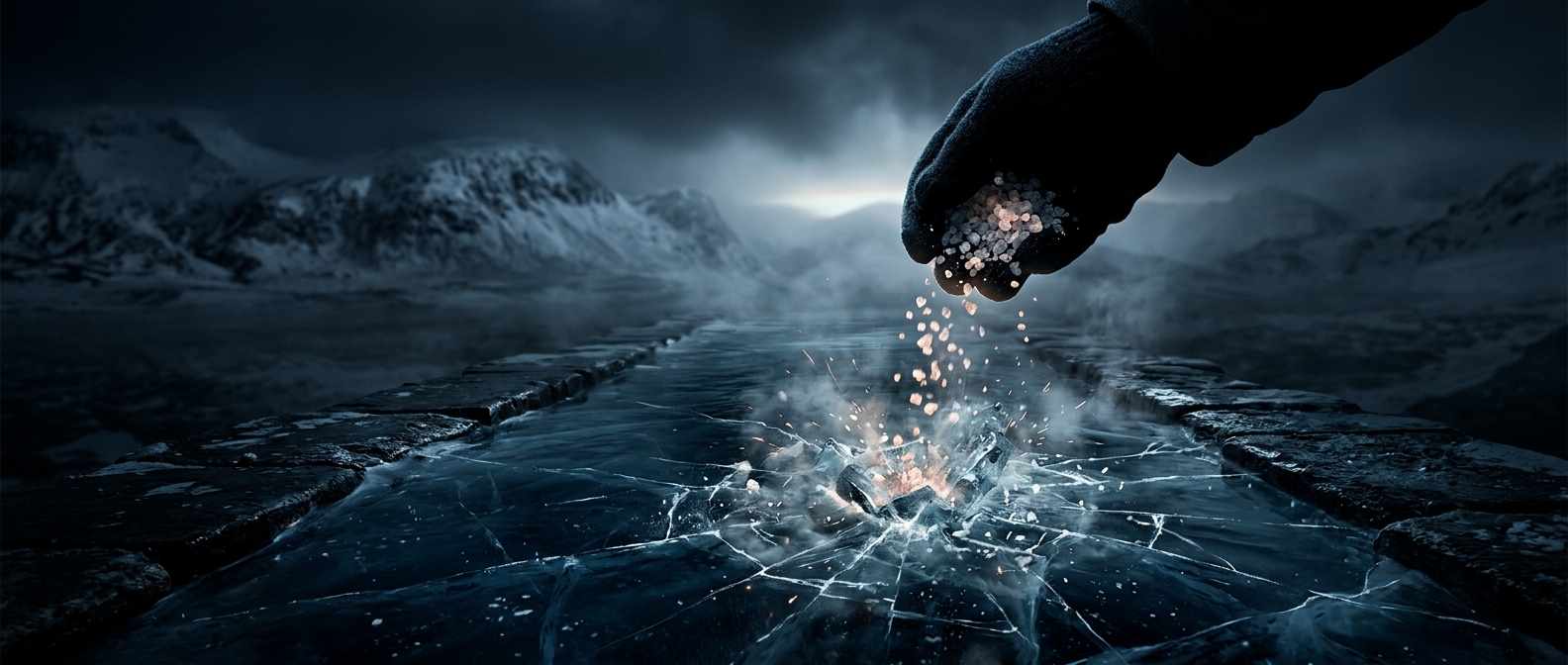
Ice is not always a perfectly dry, solid surface. A microscopic film of liquid water can exist on it, and salt dissolves into that film. The dissolved salt disrupts the way water molecules line up to form ice, so the salty water must get colder than fresh water before it freezes. This is called freezing-point depression.
As long as the brine—the mixture of salt and water—stays liquid, it can spread under and around ice crystals. More ice then melts into the brine, enlarging the wet layer and helping break the bond between ice and pavement. The salt does not heat the path; it changes the conditions under which water can remain liquid.
Why it stops working in severe cold
Salt’s effect has limits. As the temperature drops, the brine becomes more concentrated and can eventually freeze too. Ordinary rock salt is useful over a practical range of winter temperatures, but below that range it melts ice slowly or not at all. Spreading more salt cannot overcome that physical limit.
That is why salt works best when it can dissolve and form brine, and why very cold, thick ice may need to be cleared mechanically rather than relying on salt alone. Its useful trick is not to make winter warm, but to keep a thin layer of water from refreezing at temperatures where plain water would turn solid.