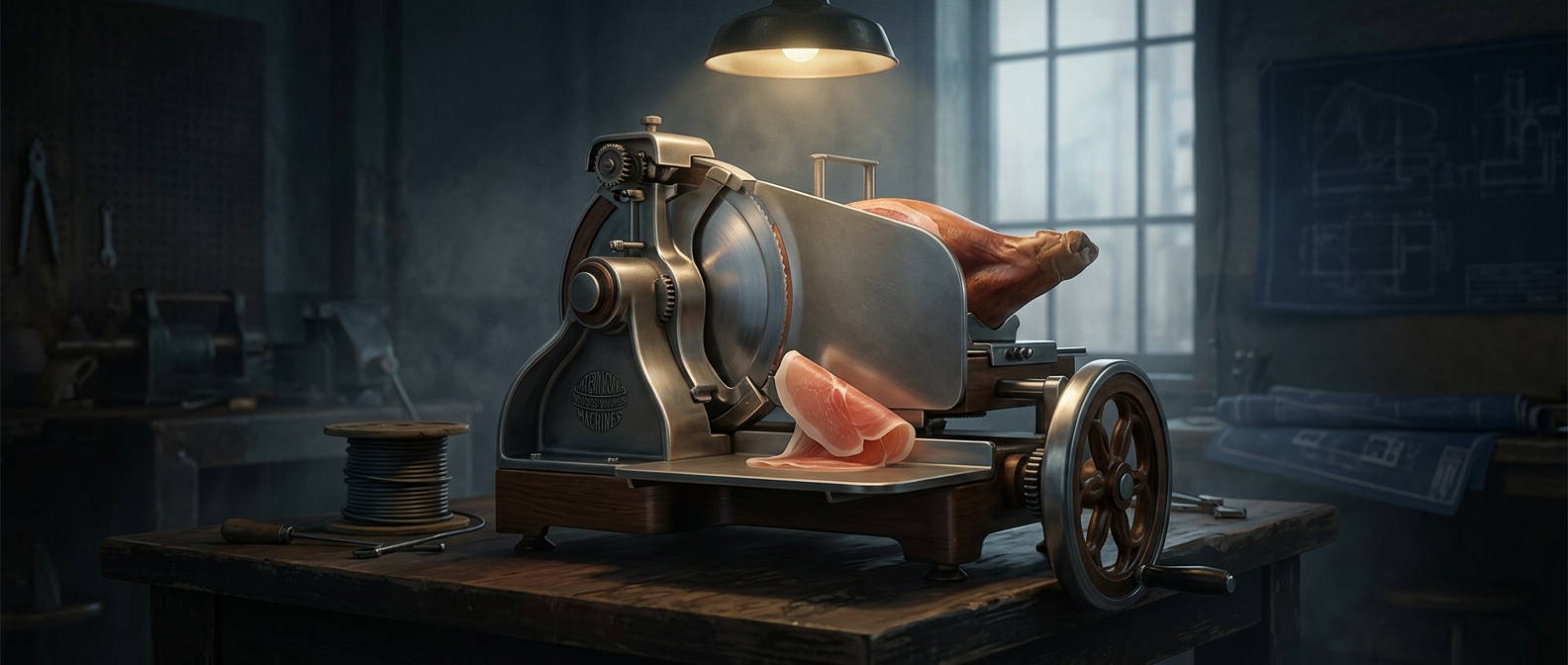
IBM’s early business was a collection of machines
The cheese slicer was not a quirky side project added by a computer company. IBM inherited a much broader business when it was formed in 1911 as the Computing-Tabulating-Recording Company, or CTR. The new company brought together several firms that made equipment for workplaces, including commercial scales, time-recording devices, tabulating machines—and slicers for meat and cheese.
That range makes more sense when you look at the customers: shops, factories, and other businesses that needed dependable machines to handle everyday work. A retailer might weigh goods and slice food; an employer might track workers’ hours; a large organization might use tabulating equipment to sort and count information.
From slicing food to processing information
The products did not all share one technology. A slicer physically cut food, while a tabulator handled information using cards and mechanical equipment. What connected them was the company’s role as a supplier of practical business machinery—not a single, narrow specialty.
In 1924, CTR adopted the name International Business Machines, later shortened to IBM. As the company increasingly became associated with data processing and computers, its earlier product mix faded from view. The cheese slicer is a reminder that IBM’s path to computing began inside a much wider enterprise: one that once sold machines for both handling information and preparing lunch-counter staples.