Why a Dragon-Turtle Carries Stone
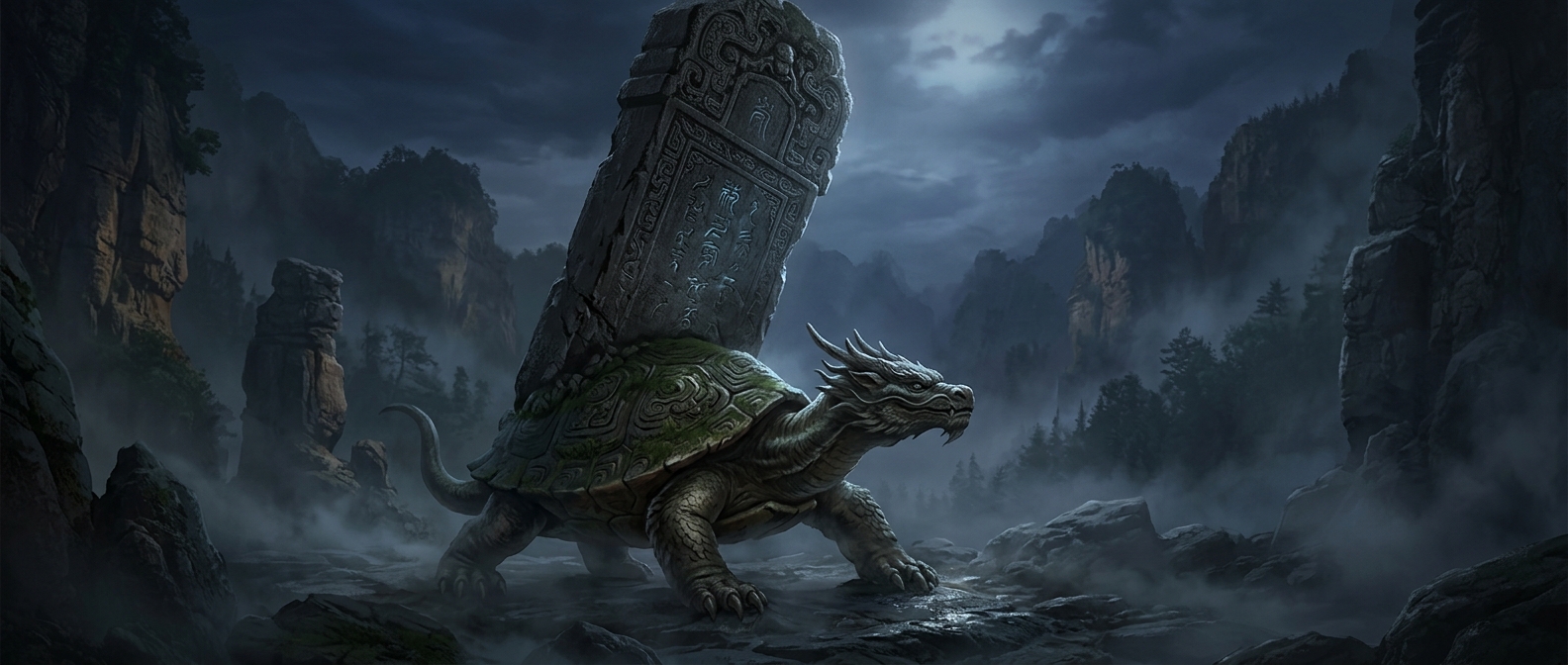
Bixi (pronounced roughly “bee-shee”) is a legendary creature with a dragon’s head and a turtle-like body. In Chinese tradition, he is often counted among the dragon’s nine sons, though accounts of the nine vary. His defining role is to bear heavy stone monuments—a task that turns his legendary strength into a visible part of the monument itself.
The carved slab he supports is called a stele: an upright stone tablet used to record an inscription, such as a dedication, a ruler’s achievements, or a memorial. Setting the tablet on Bixi’s back gives the written words a massive, durable foundation. The image also suggests that the creature can carry the weight of an important record across generations.
A Mythic Figure in Real Architecture
Bixi figures appear at temples, tombs, and other historic sites, where the creature is carved as the base beneath a stele. The pairing works on two levels: the tablet preserves a message in stone, while the powerful bearer makes its permanence tangible. A visitor encounters the inscription not as a loose slab, but as a monument supported by a creature built for endurance.
That is why the dragon-turtle is more than decoration. Its pose explains the monument at a glance: this is a record meant to stand, and Bixi is strong enough to hold it up.