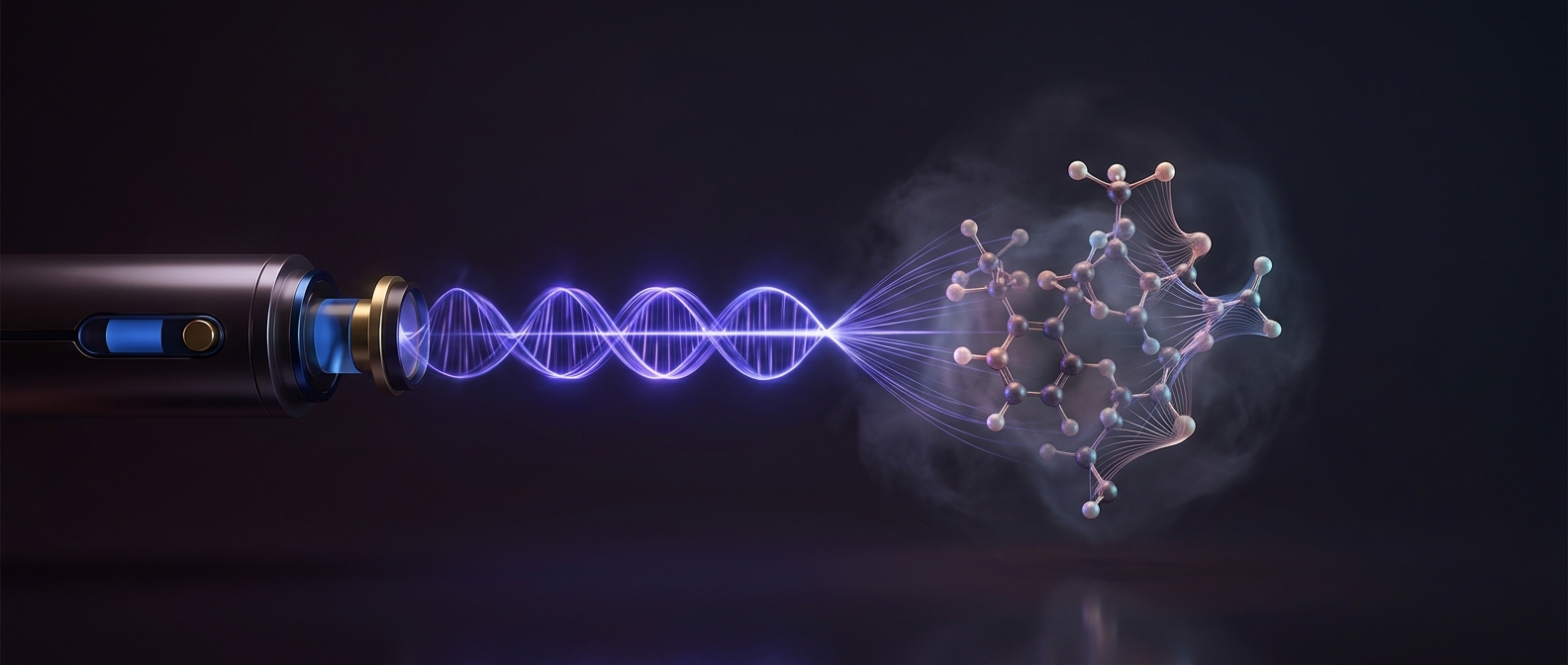
How a molecule turns polarization
A polarimeter tracks the orientation of polarized light before and after it passes through a sample. In a chiral substance—a material whose molecules have a handed, mirror-image form—the two circular components of the light can travel at slightly different speeds. When they recombine, their relative timing has shifted, turning the light’s polarization axis. The direction of that turn depends on the molecule’s handedness.
This is optical activity. A sample containing equal amounts of the two mirror-image forms tends to cancel their opposite rotations, so the measured signal can also reveal whether one form is more abundant.
What twisted light adds
Ordinary light beams have a fairly uniform wavefront. A twisted light wave has a phase that winds around its direction of travel, like a spiral staircase; this pattern gives the beam orbital angular momentum, distinct from the polarization’s own rotation.
That structured pattern changes how the light’s electric field is arranged across the beam. Because chiral molecules respond differently to different light fields, researchers can use twisted light to probe handedness through its interaction with the sample. The key idea is not that the beam simply “matches” a molecule’s shape, but that the altered light–matter interaction can carry information about molecular chirality.
Reading the signal
A detector measures the light after it leaves the substance, and the result can be compared with the incoming beam or with measurements made using different light patterns. Any handedness-sensitive change provides a clue about the sample’s molecules. In practice, the signal depends on the beam, the material, and the measurement setup; twisted light is a way to add another probe, not a universal shortcut.
The practical promise is a richer optical fingerprint: a sample’s response to a spiral wave can help distinguish molecular handedness that a simple visual inspection could never reveal.