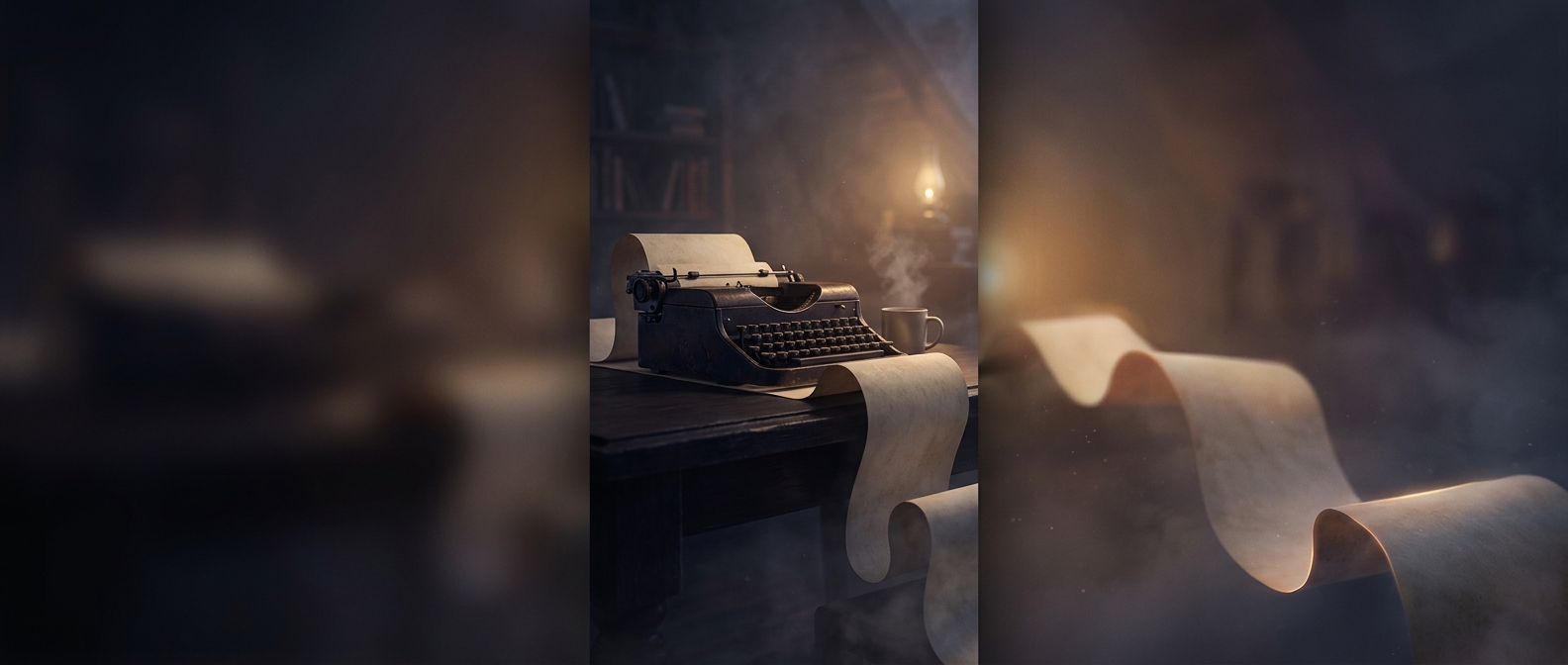
A manuscript built for momentum
A conventional typewriter feeds one sheet at a time: when the page fills, the typist has to stop, remove it, insert another, and resume. Kerouac’s long roll eliminated that small but recurring break. With the paper joined end to end, he could keep typing forward instead of managing a stack of pages.
That choice suited a draft driven by continuous movement. A roll has no natural page boundaries, so a sentence or scene can run on without being forced to end at the bottom of a sheet. The format did not make revision impossible, but it made the draft physically different from a bound book: readers must follow the text along a strip rather than turn pages.
From typing surface to historical object
The roll’s scale also changed what happened to the manuscript after the writing stopped. Separate pages can be filed, shuffled, or lost one by one; a continuous strip preserves the draft as one long object. Its length makes the act of typing visible in a way a finished volume cannot: the reader encounters not just a story, but a sustained stretch of work laid out in paper.
That creates a practical tradeoff. A scroll is useful for uninterrupted writing, but awkward to store, inspect, and display. When museums exhibit it, the format that once kept the typewriter moving becomes part of the experience: visitors see a novel’s draft as a physical journey through a single, unusually long sheet.