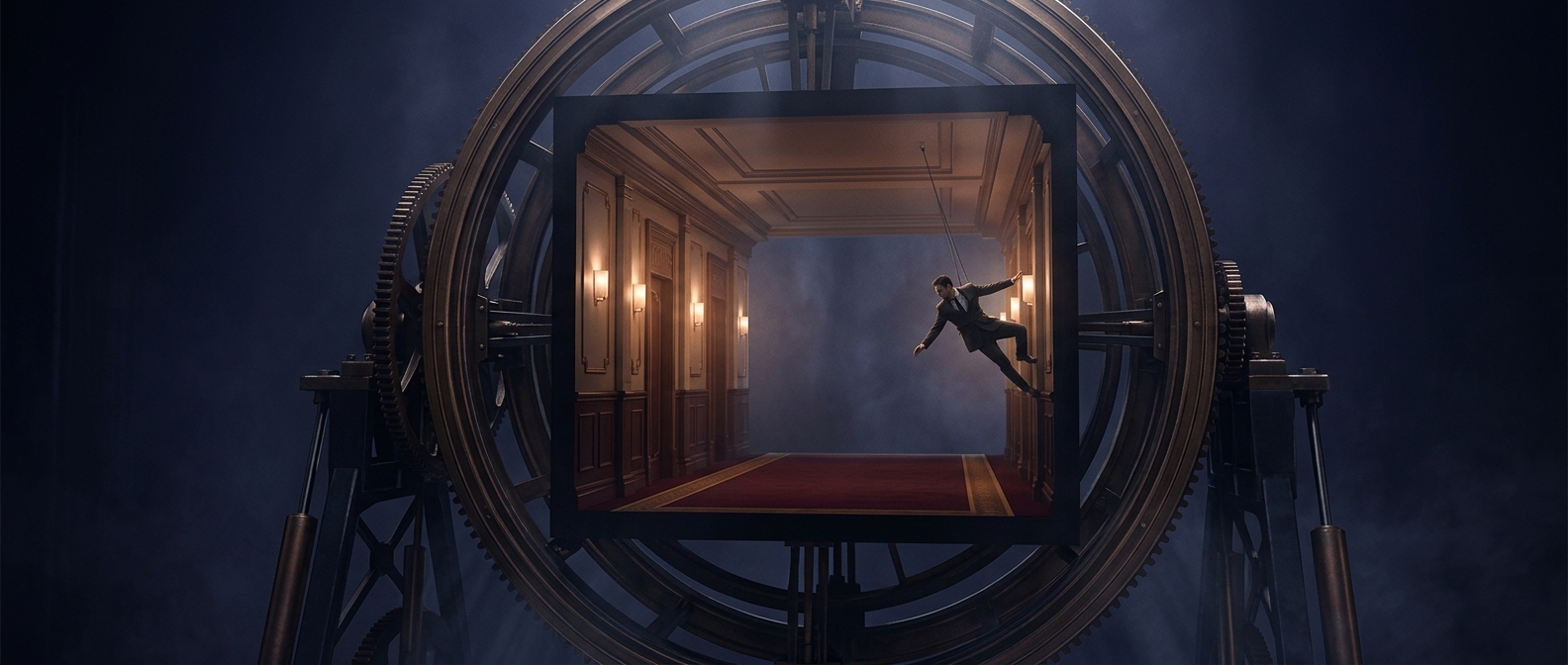
How Inception made a hallway turn into a fight partner
The corridor fight in Inception had to make a familiar space seem to lose its orientation. Rather than create the entire effect with computer graphics, the crew built the corridor inside a rotating steel structure. When the structure turned, the set’s walls and floor moved around the performers, giving the camera a physical scene to photograph.
That choice changed the stunt problem. Joseph Gordon-Levitt and the stunt performers could not simply fight on a stable floor while a digital hallway spun behind them: their footing, balance and timing had to work with the moving set. A surface that looked like a floor at one moment could become a wall as the corridor rotated. The performers’ movements were choreographed to make those shifting surfaces feel like part of the action.
The trick depends on what stays still
The set did not cancel gravity. Gravity continued to pull the actors downward; what changed was the room’s orientation around them. By coordinating the rotating corridor, the performers and the camera, the filmmakers could make a grounded physical movement read as a person being carried through a tumbling space.
That distinction is what gives the sequence its disorienting effect. A digital image can show a room turning, but a practical rotating set makes the performers’ contact with the walls and floor change in real time. Their balance and impacts provide visual cues that the space itself has become unstable.
The result is more than a background gimmick: the hallway becomes an active force in the fight. Every turn changes which surface can support a body, so the choreography has to treat the architecture as both setting and opponent.