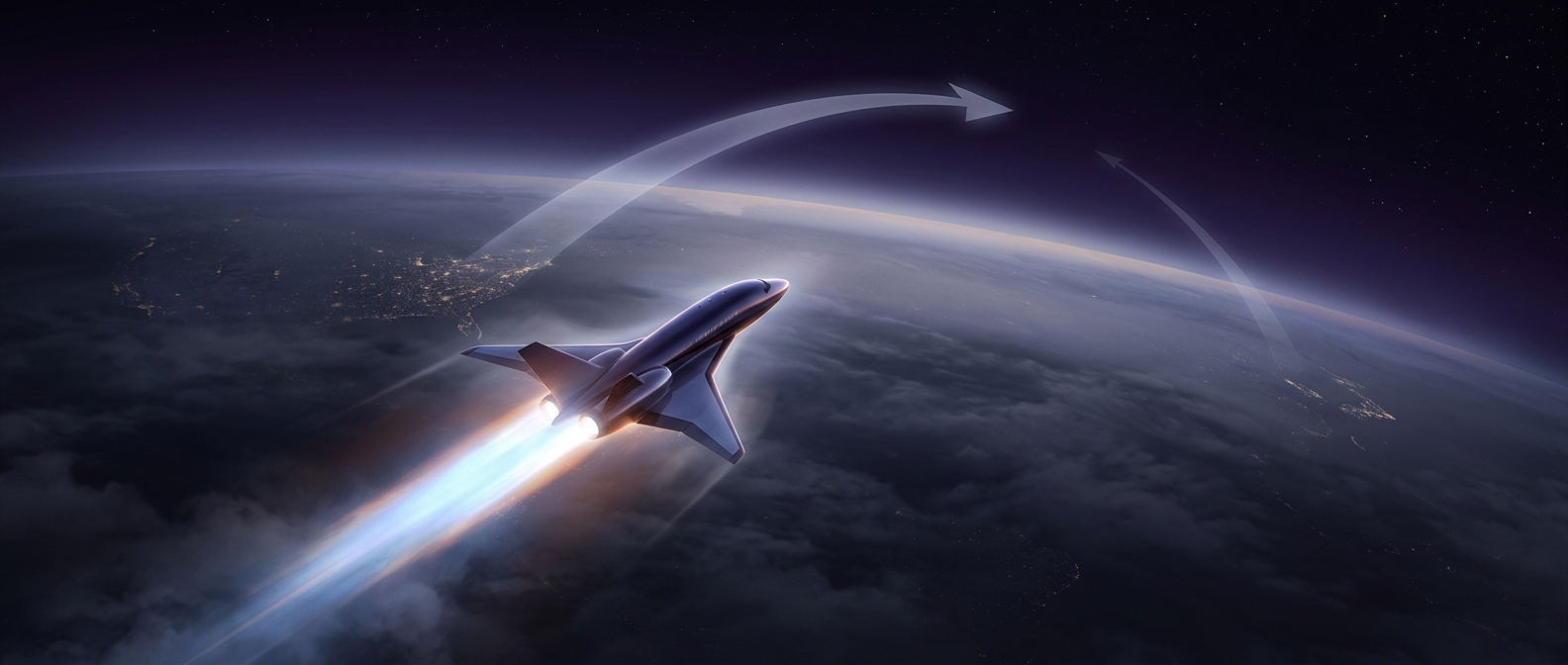
The hard part is staying fast without losing the air you need
“Hypersonic” means faster than five times the speed of sound. At those speeds, crossing the distance between New York and Tokyo can take far less time—but the aircraft cannot simply behave like a conventional jet with a bigger engine. It must manage two competing demands: thinner air reduces resistance, yet an air-breathing engine needs oxygen from that air to keep producing thrust.
Proposed spaceplane concepts approach the tradeoff in different ways. Some would use engines that take in and compress atmospheric air during part of the flight; others would use rocket propulsion to climb high, then glide through the upper atmosphere. The design determines how much of the trip is powered, how high the vehicle flies, and what it must carry onboard.
Speed turns the atmosphere into a heating problem
Even where the air is thin, a vehicle moving at hypersonic speed violently compresses the air in front of it. That compression heats the surrounding gas and transfers heat to the aircraft. The skin, joints, windows, and engine inlet all have to withstand that punishment, while the vehicle remains controllable and its structure stays within safe temperatures.
This is why a heat-resistant exterior is not just protective armor. It is part of the vehicle’s operating system: materials and cooling methods have to keep heat from damaging the structure or the equipment inside. Reducing drag by flying high helps, but it does not make the thermal challenge disappear.
A fast route is also a difficult flight corridor
A plane traveling at these speeds would need more than a workable engine and heat shield. Its climb, descent, noise, and operating limits would shape where and when it could fly. The one-hour journey is therefore a design goal built around a whole flight profile—not simply a faster version of today’s airline route. The aircraft would have to solve the hardest conditions precisely where speed makes every mistake more costly.