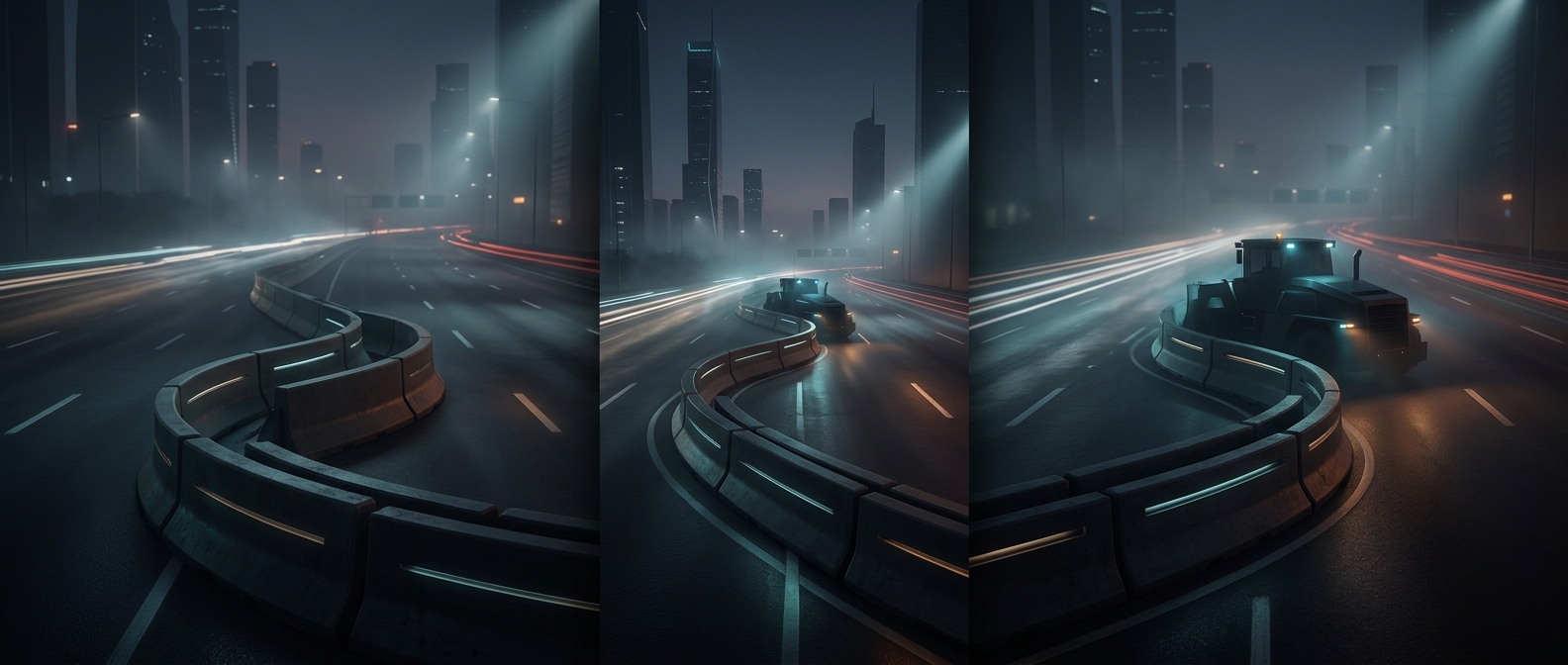
How the barrier line changes sides
The key is that the concrete units are built to connect end to end. Their shaped joints let the line act as a linked barrier while still allowing the machine to separate and guide the blocks through its transfer path. As the machine travels, it picks up the connected line, moves it laterally, and places it back down. The road does not need a crew to lift and reposition each heavy unit individually.
A lane becomes available when demand shifts
This makes a barrier useful as a movable boundary, not just a fixed divider. On a road where traffic is heavier in one direction at certain times, operators can shift the line to give that direction more lanes and leave fewer for opposing traffic. Later, the boundary can be moved back. The concrete still separates traffic; what changes is which pavement lies on each side of it.
That flexibility comes with a constraint: the road must be arranged so the barrier can be transferred along its length, and the change is made by a large, slow-moving machine rather than by instantaneously changing markings. The payoff is a way to adapt lane space without rebuilding the road. A boundary that once seemed permanent can move with the daily traffic pattern.