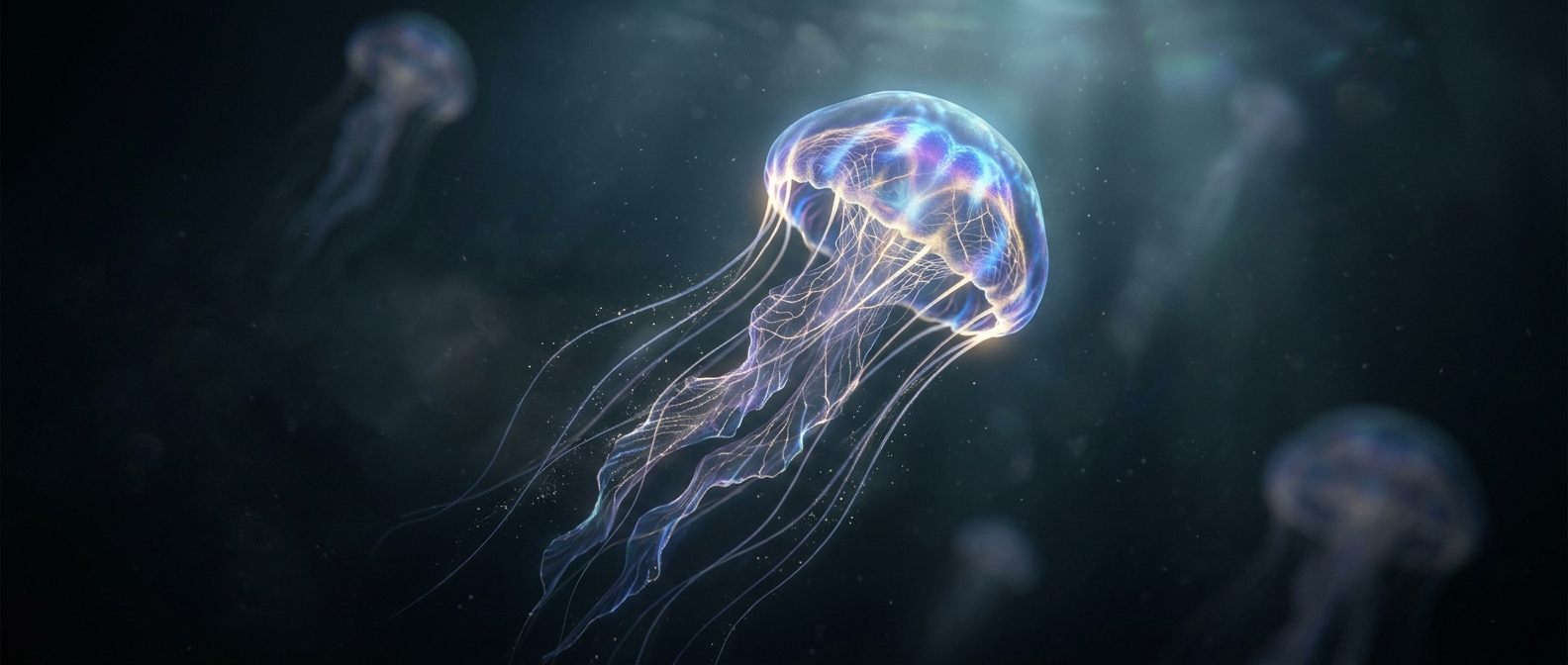
How a Jellyfish Gets By Without a Heart
Jellyfish have no blood-filled circulatory system to carry oxygen and nutrients around. Their bodies are thin and made largely of water, so many of their cells lie close to the surrounding seawater. Oxygen dissolved in that water can pass through the body surface and into cells, while waste products diffuse back out. When tissues are only a short distance apart, a pump and branching blood vessels may not be necessary.
A Nerve Net Instead of a Command Center
A jellyfish’s movement is coordinated by a nerve net: nerve cells spread through the body rather than gathered into a brain. When signals travel through this network, muscles around the bell contract, squeezing water out and pushing the animal forward. The bell then relaxes and refills, ready for another pulse.
This arrangement does not provide the centralized processing found in animals with brains. Instead, it supports the jellyfish’s relatively simple pattern of movement and response. Sensory structures around the body can detect cues such as light or contact, and the nerve net helps coordinate reactions without a single organ directing every action.
A Body Plan Matched to the Job
The lack of a heart and brain is not a missing piece that the jellyfish must compensate for with hidden organs. It reflects a different set of demands: a small, soft body with cells close to the water and movement driven by repeated bell contractions. Its simplicity has limits, but it is enough for the basic tasks of sensing, swimming, and exchanging materials with its environment.
A jellyfish can therefore keep moving without pumping blood through its body: the surrounding water is close enough to do much of the delivery work directly.