Reading a sky that never holds still
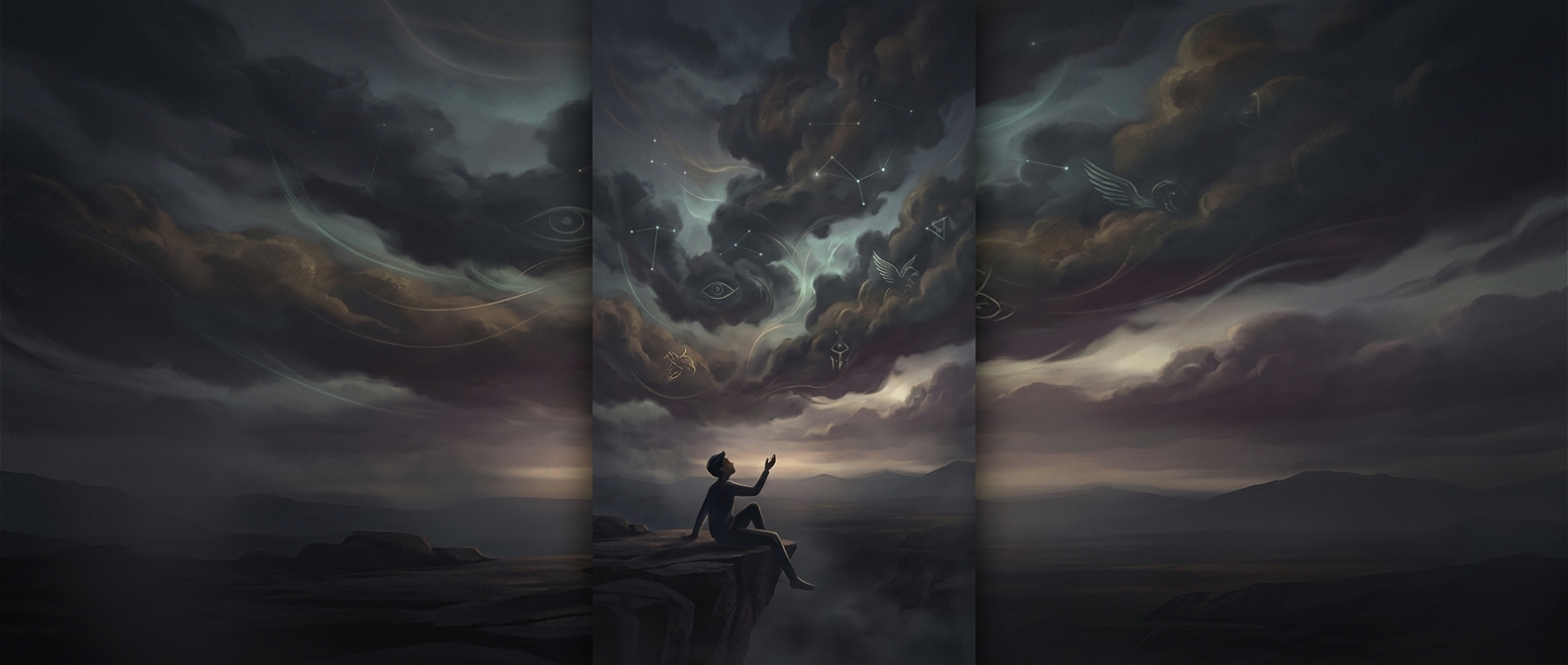
Nephomancy treats clouds as more than weather: their forms become prompts for interpreting what may happen. A practitioner watches a passing cumulus cloud, notices a shape or movement, and assigns it meaning within a divinatory reading. Because the cloud changes as it drifts and breaks apart, the reading is tied to a brief moment rather than to a fixed object.
The practice depends on interpretation, not on a stable code that makes every cloud mean the same thing. One viewer might see an animal, a face, or a familiar scene; the significance comes from connecting that image to a question or circumstance. The cloud offers a suggestive shape, while the reader supplies the context.
Why clouds invite divination
Cumulus clouds have distinct outlines, but their edges are constantly reshaped by wind and changing air. That combination makes them especially easy to read as recognizable forms—and difficult to interpret in exactly the same way twice. The experience resembles finding shapes in a flickering fire: attention settles on a pattern, and the pattern becomes a starting point for thought.
For someone practicing nephomancy, that openness is part of the method. A cloud reading can turn uncertainty into a story about possibilities, but it should be understood as divination rather than a scientifically established way to predict events. Its memorable feature is the transformation: an ordinary cloud becomes a temporary symbol, visible only until the sky reshapes it.