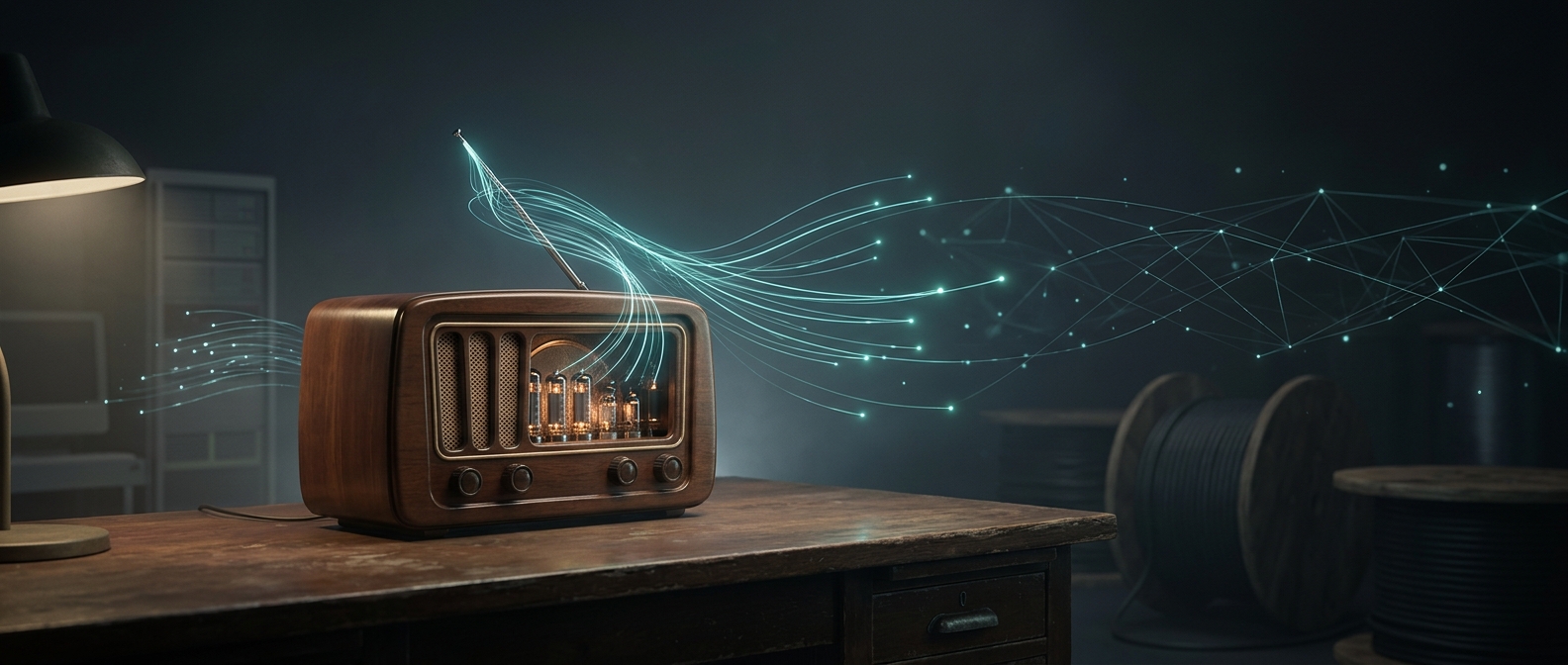
A live band took the internet beyond one-to-one communication
In 1993, Severe Tire Damage played live as its performance was transmitted over the internet. The important change was not simply that listeners could hear music through a computer. It was that a live event could be sent across a network built mainly to move data between individual computers—and reach listeners in different places at once.
How one signal could reach many listeners
The broadcast used the Mbone, an experimental system for sending multicast traffic. In an ordinary one-to-one connection, a server sends a separate copy of data to each recipient. Multicast lets network equipment copy the stream at points along its route, so one transmission can branch toward many listeners without the sender having to make every copy itself.
That mattered for live audio. The sound had to be converted into digital data, divided into small packets, and sent across networks that were not designed as a dependable, continuous broadcast channel. If packets were delayed or lost, the audio could stutter; listeners also needed compatible software and access to the experimental network. This was a very different experience from clicking a play button on today’s streaming services.
A glimpse of what the network could become
The performance demonstrated a new possibility: the internet could carry a shared, real-time cultural event, not just files and text exchanged between machines. The technology was still limited and technically demanding, but its basic idea—send live media as network data, then let it travel to audiences far away—became central to internet radio and streaming.
The memorable shift was from downloading music after the fact to hearing a band while it was playing, with the network itself serving as the broadcast path.