A dial added complexity—and a new pattern
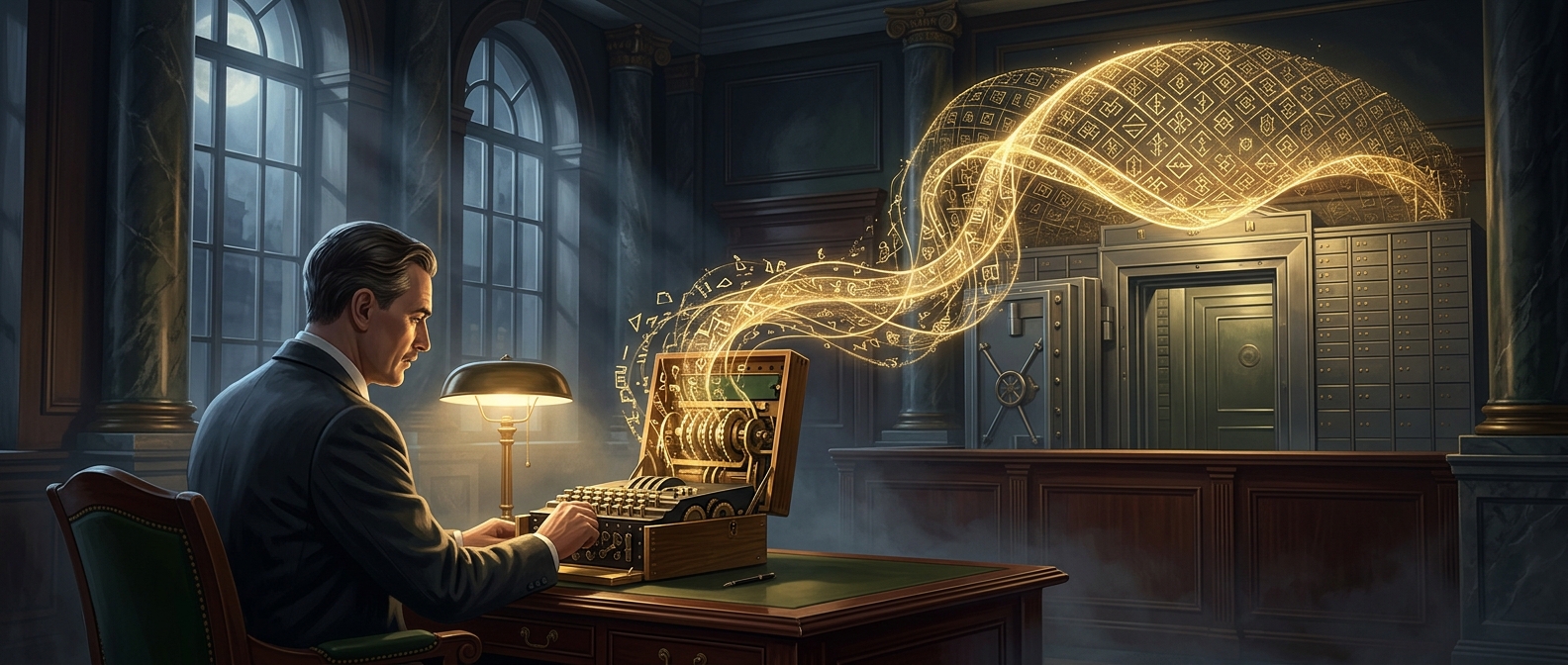
The Luftwaffe’s Enigma “Uhr,” or clock, was an attachment to the machine’s plugboard: the panel where cables swapped pairs of letters before and after the rotor mechanism scrambled them. The Uhr offered 40 dial positions, changing how those cable connections behaved. It was meant to make the plugboard’s contribution harder to predict.
Ordinary Enigma plugboard swaps were reciprocal: if A became B, B became A. The Uhr could produce a more complicated, non-reciprocal mapping—an input letter did not necessarily map back the same way when the direction was reversed. That disrupted assumptions that could help narrow the possibilities in an Enigma message.
More settings, but a fixed device
A larger number of possible settings does not automatically make a cipher stronger in practice. The Uhr’s wiring and range of positions were fixed. Once codebreakers understood how the attachment worked, they could account for its behavior rather than treat it as an unknowable extra layer. The device added choices for operators, but it also gave analysts a defined mechanism to study.
The dial could also make setup less intuitive. Operators had to set it correctly alongside the machine’s other daily settings. A mis-set control could make a message unreadable to its intended recipient, while a predictable or repeated procedure could give codebreakers useful structure. The Uhr did not simply reveal messages; it created another system whose operation had to be reconstructed.
The human cost of added security
That is the paradox behind the upgrade: the Uhr complicated interception, yet its fixed design and operational demands offered new avenues for analysis and mistakes. Its 40 positions expanded the possible configurations, but each position was still part of a limited, testable device. The extra dial was therefore both a barrier and a clue—one more setting Luftwaffe crews had to manage, and one more mechanism Allied codebreakers could learn.