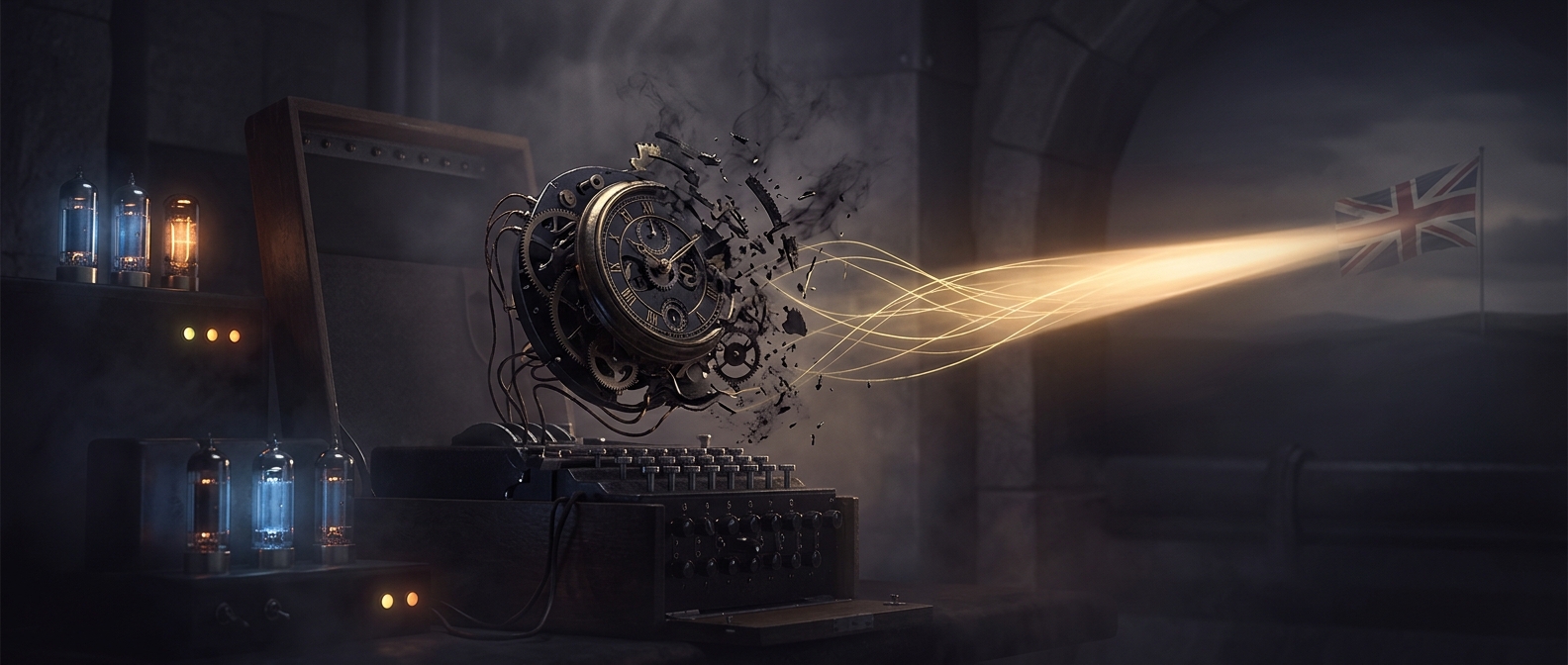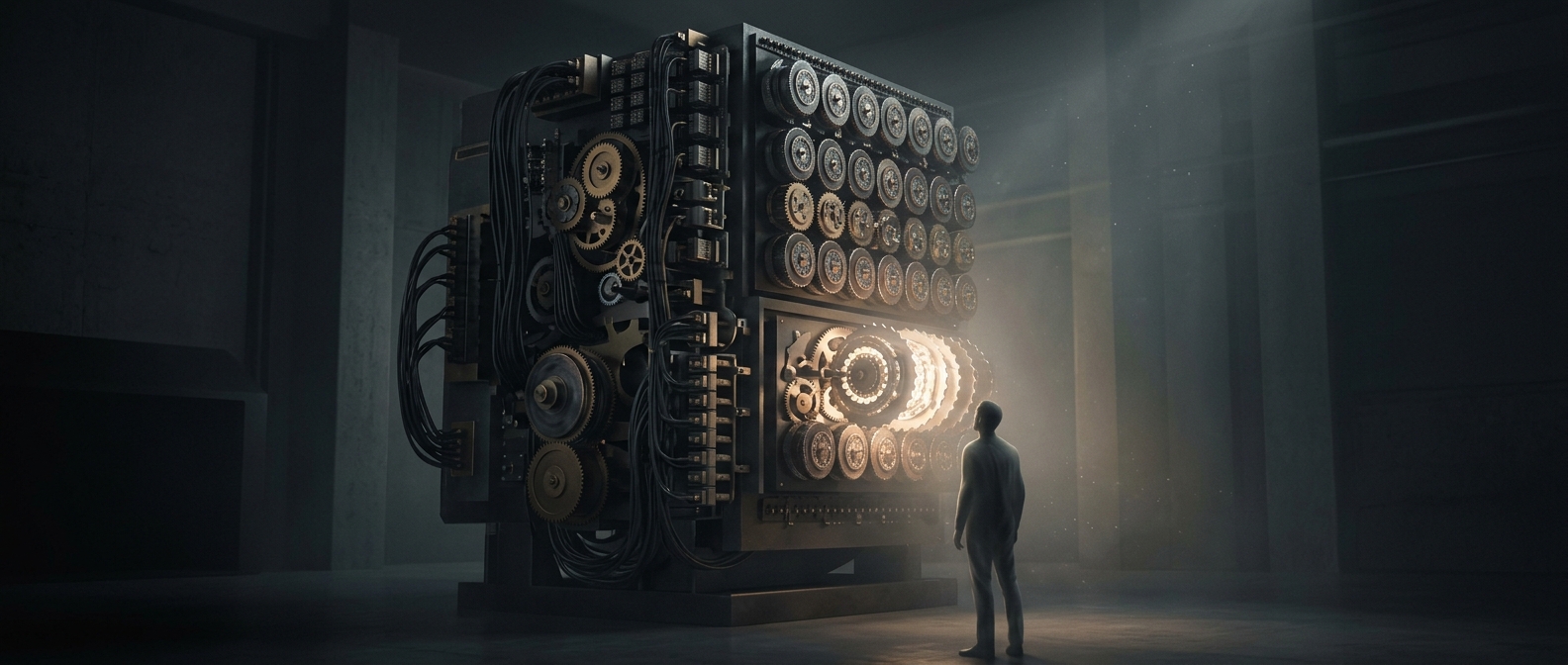
The Bombe searched for contradictions, not messages
A Bombe did not print out German plaintext or try every possible Enigma setting one by one. It tested whether a proposed arrangement of rotor positions could fit a relationship between a suspected piece of plaintext and the intercepted code.
Cryptanalysts often had a crib: a plausible guess at a phrase in a German message, perhaps based on its routine subject or format. They lined that guess up with the ciphertext and traced how Enigma would transform each letter under different rotor settings. One useful quirk was that Enigma never turned a letter into itself. If a proposed alignment required a letter to match itself, that setting could be rejected immediately.
Why the machine could narrow the search
The Bombe’s rotating drums reproduced the letter-swapping behavior of Enigma’s rotors. Set up to represent a crib’s pattern, they ran through rotor positions and checked whether the resulting relationships could coexist. A contradiction meant a candidate setting was impossible; a surviving stop meant it was worth investigating, not that the message had already been solved.
This distinction mattered because Enigma’s plugboard added another layer of letter swaps. The Bombe’s stops gave codebreakers promising rotor settings, while further checks—often involving the plugboard—helped determine whether a stop was genuine. Analysts could then use the recovered settings to read messages encrypted with the same key arrangements.
Human judgment remained part of the process
The machine’s speed was useful only when people supplied a good crib, translated it into the right test, and checked the results. A poor guess could produce no useful stops; a plausible one turned the Bombe into a powerful filter, discarding vast numbers of impossible settings without requiring operators to read each possibility as a message.
That division of labor was the breakthrough: people recognized patterns in German communications, and the machine rapidly tested their implications. The Bombe did not replace codebreakers—it let them spend their attention on the few settings that survived its contradictions.