A coin for a dangerous crossing
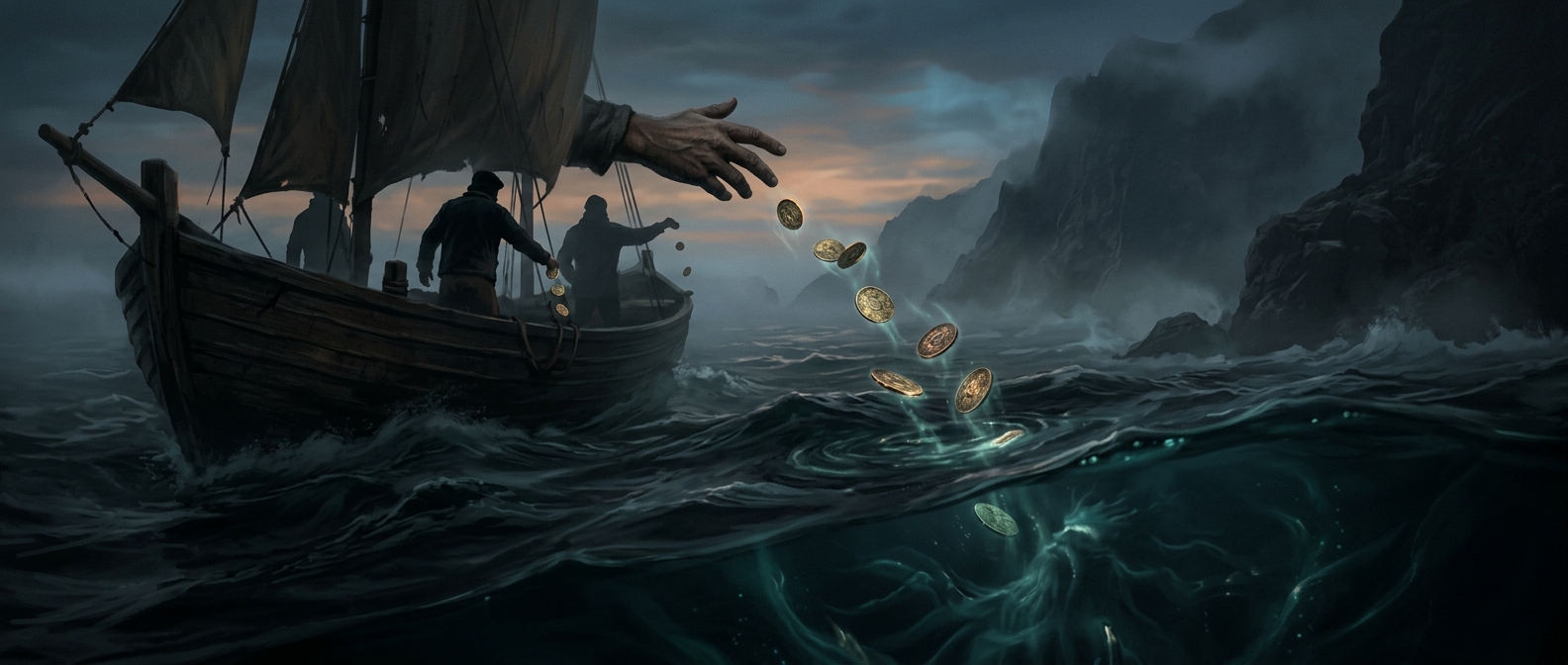
For sailors who believed the sea was governed by powerful beings, a voyage was not only a test of skill. It was also a passage through a realm whose rulers could not be seen and whose moods could not be controlled. Dropping a coin into the water made that uncertainty tangible: the offering was a small payment to seek favor or avert harm.
Calling it “rent” captures the imagined bargain, but not necessarily a single, uniform custom. Maritime offerings varied across places and traditions. A coin could be given to a sea god, a local spirit, or another power associated with a particular stretch of water. The gesture expressed respect and dependence, not a claim that a payment could guarantee safe passage.
Why the sea invited offerings
At sea, danger could arrive without warning. A current might carry a vessel off course; a squall could overwhelm it; and a crew far from shore had few ways to summon help. Sailors could steer, watch the weather, and maintain their ship, but they could not command the forces around them. Religious practice offered a way to acknowledge that limit and to ask for protection when practical measures were not enough.
A coin was suited to the gesture because it was portable, valuable, and easy to give. Its descent beneath the surface also made the offering feel like a message delivered into an unseen world. The water concealed what happened next, just as the forces sailors feared were hidden from view.
A ritual, not a navigation tool
The offering did not replace seamanship. It belonged to a different kind of response: one directed at fear, obligation, and hope rather than at the mechanics of a current or storm. For a crew facing a perilous crossing, tossing a coin could mark the moment they entrusted themselves to powers they believed were beyond human control.