The geometry behind Vault Boy’s thumbs-up
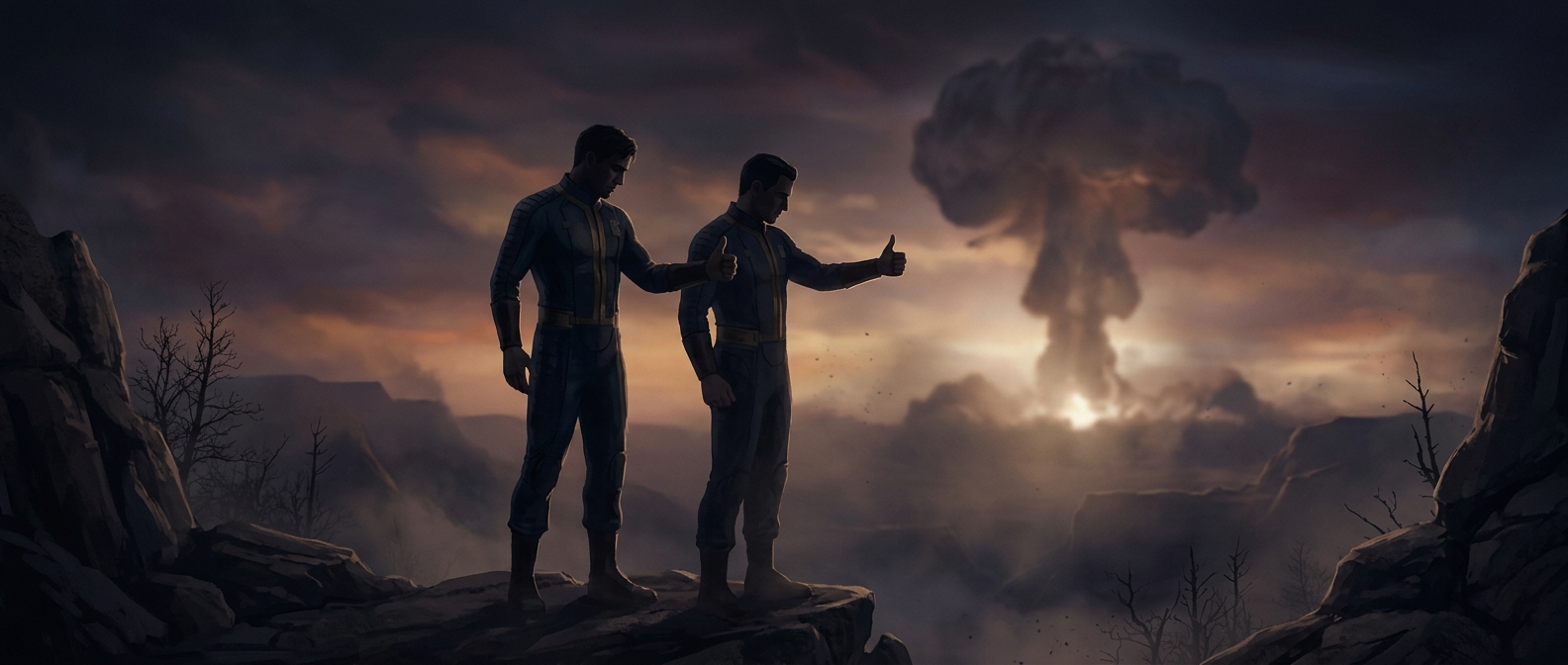
The gesture was a crude visual range check. With your arm straight, your thumb takes up a small slice of your field of view. If it appeared wide enough to hide a mushroom cloud, the old rule treated that as a sign the blast was far away.
The comparison relies on apparent size: the farther away something is, the smaller it looks. Your thumb stays roughly the same apparent width when held at arm’s length, while a distant cloud seems to shrink against it. The thumb was not measuring radiation; it was offering a quick, improvised way to judge distance by sight.
Why the rule could not promise safety
A cloud’s apparent size depends on more than distance. Different explosions can produce clouds of different sizes, and the cloud’s shape and visibility can change as it rises and spreads. A visual comparison therefore cannot tell you exactly how far away the explosion was—or what conditions are like where you stand.
Nor does distance alone settle the danger. The effects of an explosion vary with its strength and surroundings, and radioactive material can be carried away from the blast. The thumb rule was a rough cue, not a reliable test for whether a place was safe.
That is the uneasy logic tucked into Vault Boy’s cheerful pose: his thumb turns a frightening, hard-to-measure event into a simple visual check, while the real answer depends on far more than what fits behind it.