Reach Changes the Load
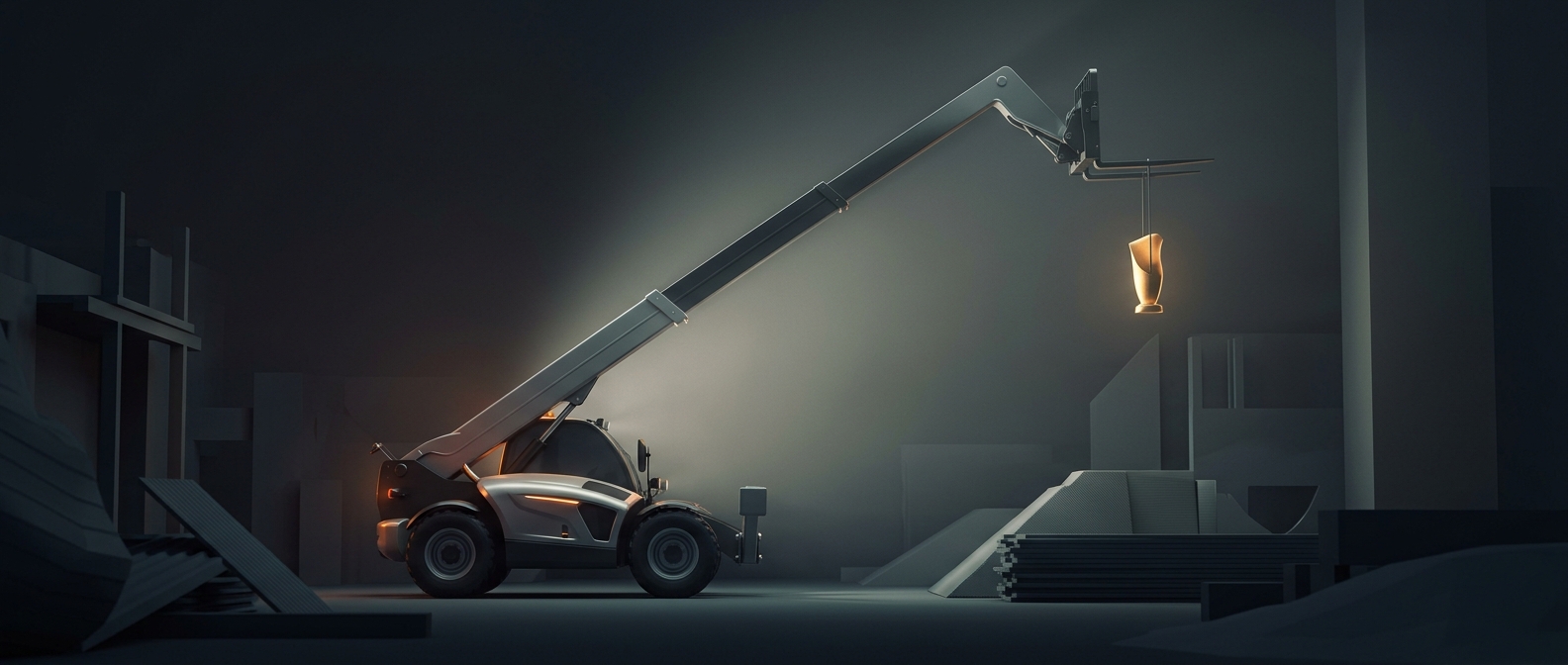
A telehandler moves a load not just upward, but outward from the machine. Its boom slides out in sections, and hydraulic cylinders raise and lower it. That lets an operator place a pallet beyond a wall, into a building, or onto an elevated platform without driving the whole machine underneath the destination.
The tradeoff is leverage. A load close to the chassis has less power to tip the machine than the same load held far away. Extending the boom shifts the combined balance point toward the front; raising it changes the machine’s stability, too. So a telehandler’s safe lifting capacity is not one fixed number. It depends on how far the boom reaches and how high it is positioned.
The Cab Has to Manage the Reach
Operators use a load chart—usually displayed in the cab—to check what the machine can lift at a particular boom position. The chart turns a simple-looking task into a placement problem: the load’s weight matters, but so does its distance from the machine. Exceeding the limit can unload the rear wheels or tip the machine forward.
Ground conditions and the way the machine is positioned also matter. A slope, soft surface, or sudden movement can reduce the margin of stability. The boom therefore gives a telehandler unusual placement flexibility, but not the freedom to reach anywhere with any load.
One Machine, Different Jobs
Forks are the familiar attachment, but a telehandler can use other tools, such as a bucket or a work platform, when the machine and attachment are rated for the task. Each changes how weight is carried and where it acts, so the operator must account for the attachment as well as the cargo.
The practical advantage is that one vehicle can move materials across rough work sites and place them where a conventional forklift cannot easily go. Its reach is useful precisely because it keeps the machine back from an obstacle—and that same distance is what makes balance the central engineering constraint.