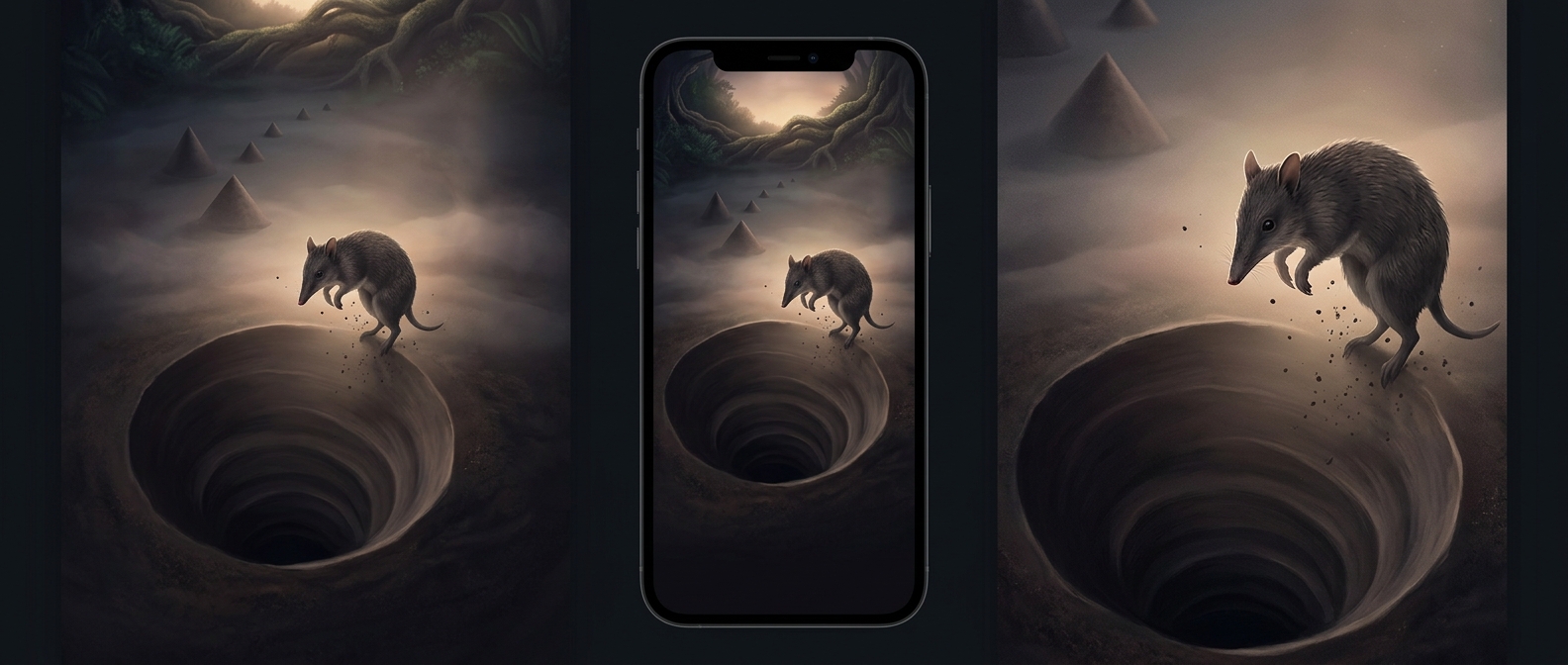
How a narrow snout makes a wide opening
A bandicoot’s pointed snout can slip into soil that would be difficult to reach with a broad, blunt nose. As the animal probes for grubs and other underground food, it pushes and loosens earth around the small entry point. The snout does not need to excavate a neat, vertical shaft: each movement breaks soil away from the sides.
Gravity shapes the hole
Once loosened, soil falls back toward the opening. Dirt near the surface has more room to spread outward as it collapses, while the deeper part remains narrower. Repeated probing and crumbling therefore leave a hole that flares upward—a cone-like shape—rather than a straight-sided tunnel.
The opening is a trace of the digging process: narrow tool, disturbed soil, then gravity widening the top. It can offer clues to the animal’s foraging, though the hole’s shape alone is not a complete record of what it found or how long it searched.
Digging changes the ground, too
As bandicoots forage, they turn over soil and expose material near the surface. The cone-shaped holes are thus more than signs of a meal hunt: each one marks a small patch of ground that has been loosened and rearranged by the search.