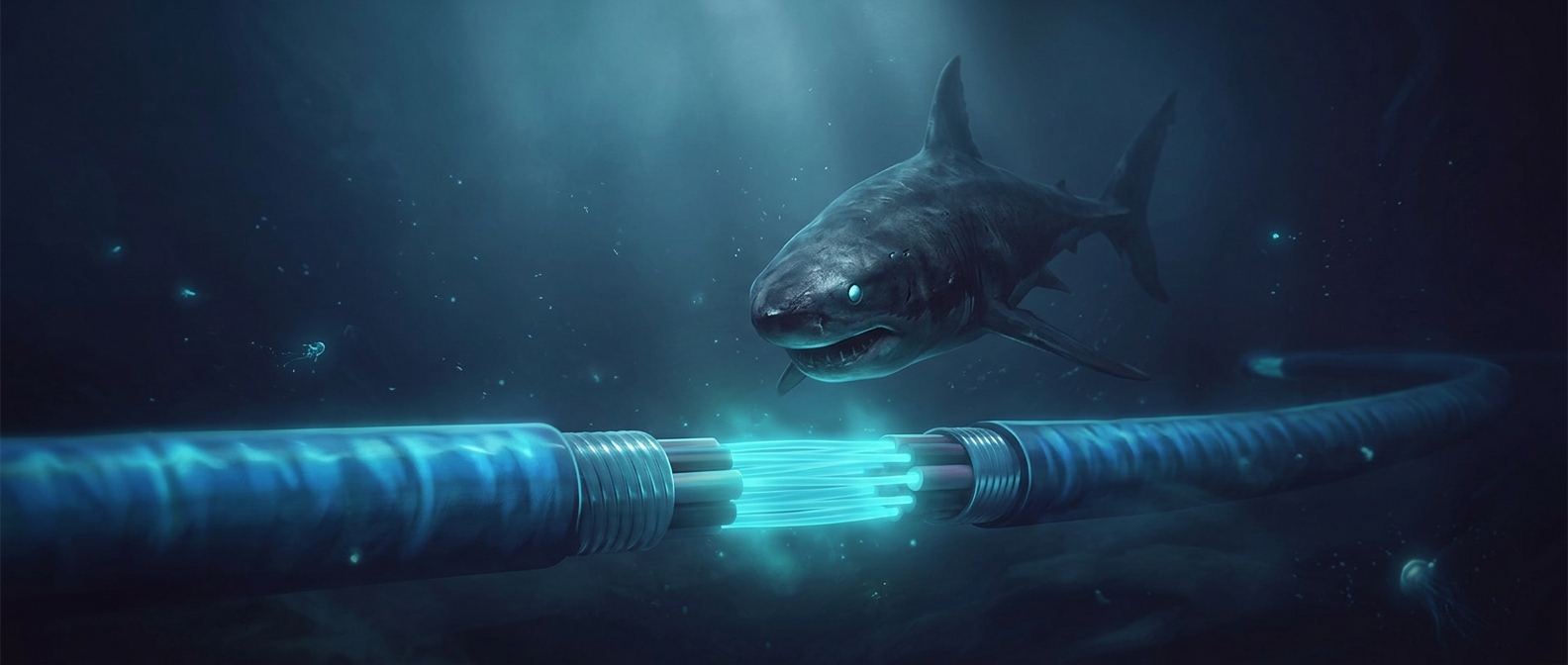
What a Shark Could Detect in a Cable
A communications cable on the seafloor carries data as pulses of light through glass fibers. But long-distance systems also use electrical power to operate equipment along the route. That current creates electromagnetic fields—patterns of energy around the cable that some marine animals may be able to sense.
Sharks have specialized organs called ampullae of Lorenzini, which detect faint electrical signals in the water. They use this sense to locate living prey, whose muscles and nerves produce tiny electrical fields. A cable’s field is not the same as prey’s signal, and it is uncertain whether sharks bite cables because they notice it. The idea is a plausible explanation, not a confirmed motive.
From Detection to Damage
If a shark investigates a cable, a bite can puncture its outer protective layers. The glass fibers inside are delicate, so damage may interrupt data traffic or require a repair crew to locate and fix the break. Cables are built with protective sheathing, and their design varies with conditions along the seabed; that protection helps reduce the risk but cannot make a cable immune to every encounter.
The intriguing possibility is that a shark’s sensory system, tuned by evolution to detect nearby animals, might also register an artificial electrical field. A bite would not mean the shark mistook the cable for food: it could be probing an unfamiliar signal. The exact reason for such bites remains unclear, but the episode illustrates how infrastructure can become part of the sensory landscape of the ocean.