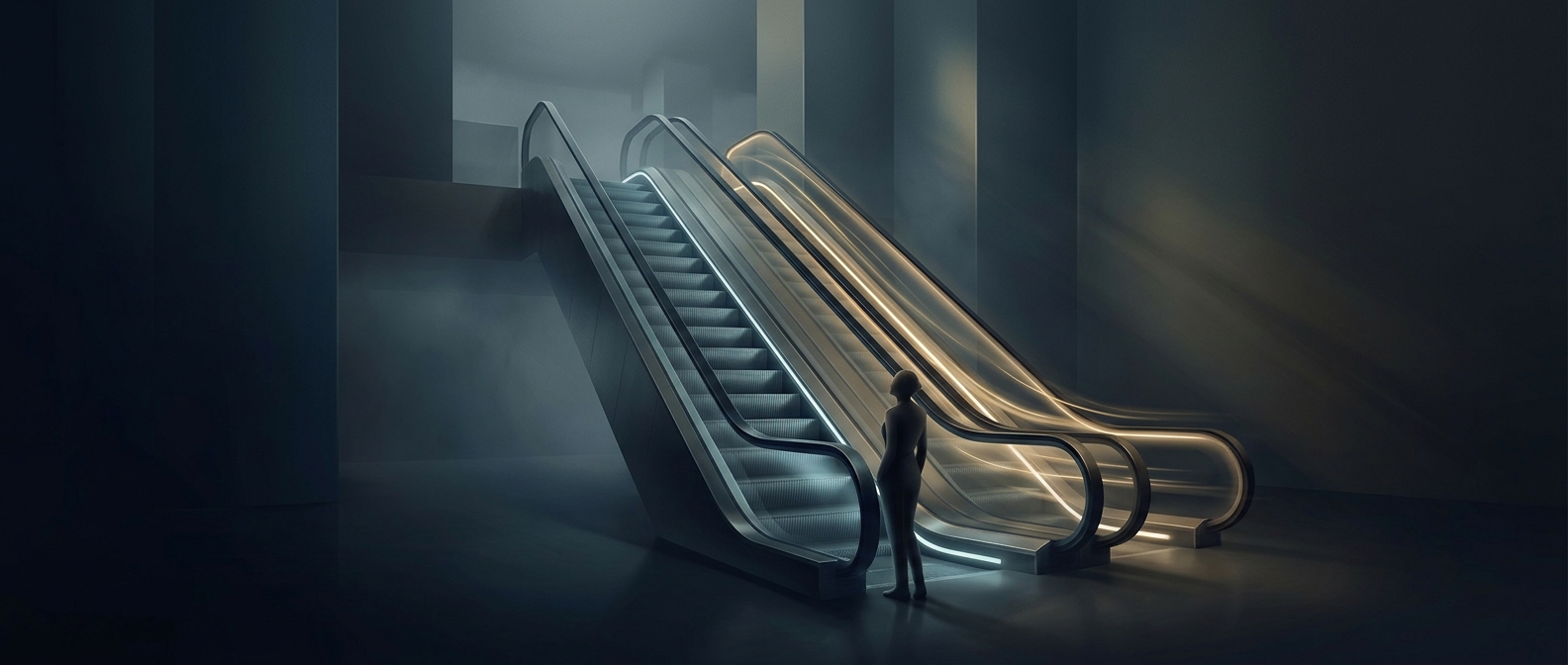
A Small Lead at the Handrail
An escalator’s steps and handrail travel in the same direction, but they do not have to move at precisely the same speed. The handrail is set to run a little faster, so a rider holding it feels a gentle forward pull. That nudge encourages a slight lean toward the direction of travel rather than a backward lean.
The difference is small: the handrail should remain close enough to the steps’ pace that a rider’s hand and feet do not feel as though they are being carried apart. The point is not to make people walk faster, but to give the upper body a subtle forward cue while the steps carry the rider upward or downward.
Keeping Steps and Hands in Sync
Inside the escalator, a motor drives a loop of steps and a separate moving loop for the handrail. Their speeds are coordinated so both keep circulating together. The handrail itself is a flexible belt that slides along guides around the escalator’s ends; its speed can differ slightly from the steps even though both are powered by the same machine.
That small mismatch matters because riders use the rail to steady themselves. A handrail that lagged behind the steps could pull the arm backward; a slight lead instead gives the rider’s hand a forward-moving support. The result is a subtle design choice with a practical effect: as the steps move, the handrail helps guide the rider’s posture in the same direction.