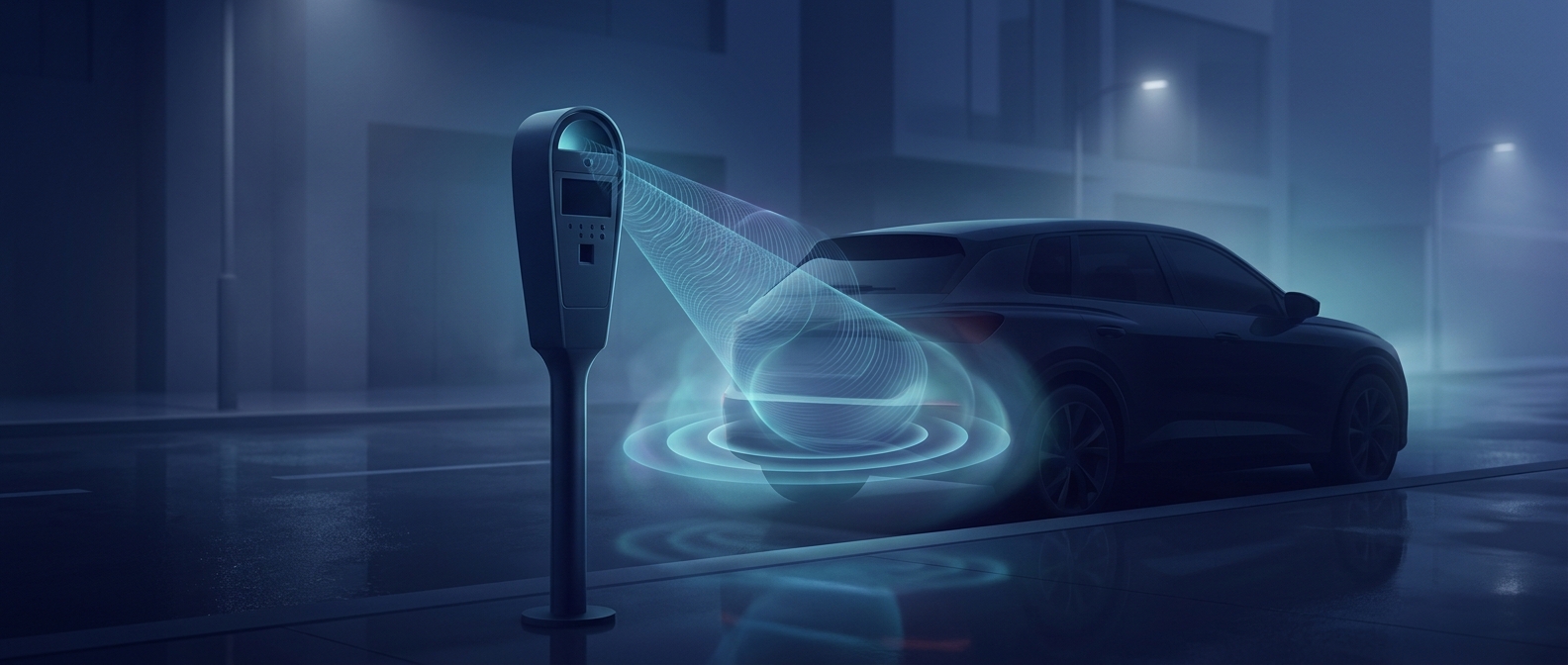
A tiny echo marks an occupied space
An ultrasonic parking sensor works a little like a bat’s echolocation. A small speaker-like part sends out a brief burst of sound above the range most people can hear. The sound travels through the air, strikes a nearby surface—such as a car’s bumper—and returns as an echo. A receiver measures how long the round trip took; because sound travels at a known speed, that delay indicates how far away the surface is.
The sensor compares that return with what it expects from an empty space. When a vehicle pulls in, the new reflecting surface changes the echo’s timing or pattern, giving the system evidence that the space is occupied. When the car leaves, the readings shift back. The device does not identify the car; it detects a change in the space.
From echo to parking information
A sensor can send its occupancy reading to a meter or a wider parking-management system, often over a wireless connection. That lets an operator see which spaces are in use without relying only on someone checking each one in person. Depending on the system, the information can also help drivers find open spaces or help staff focus enforcement where it is needed.
The practical challenge is making the reading dependable outdoors. Rain, dirt, unusual vehicle shapes, and objects left in a space can affect what the sensor “hears,” so the system must distinguish a real parked vehicle from ordinary variation. The useful trick is simple but consequential: a space can report that a car has arrived or left through the changing shape of an echo.