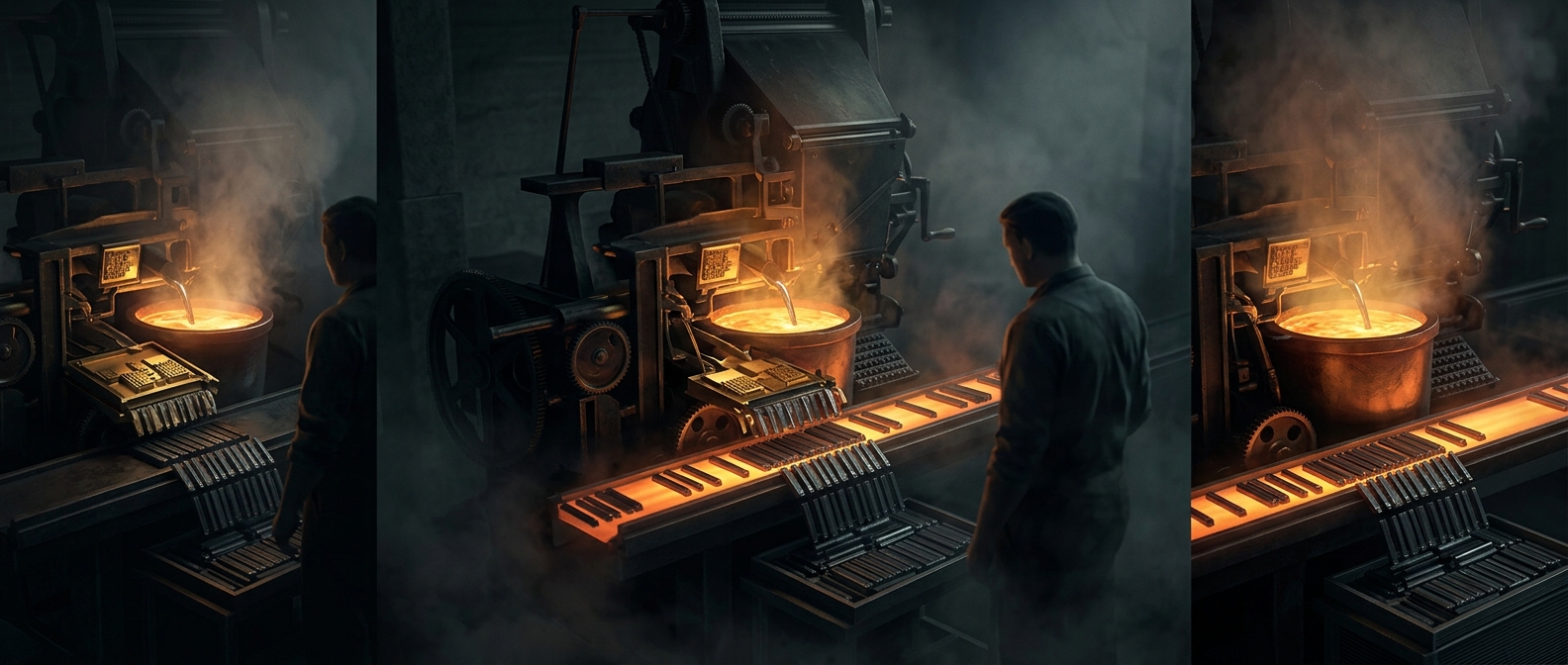
How a keyboard assembled a line of type
A Linotype operator did more than type letters. Each keystroke released a small brass matrix—a reusable piece with a letter-shaped mold—from a storage channel inside the machine. The matrices traveled down to form a line in reading order. Special wedge-shaped spaces, called spacebands, filled the gaps between words.
Before casting, the machine widened those spaces evenly until the line fit the measure, or column width. That step mattered: it made the right edge of the printed column look straight without changing the letters themselves.
One line became one piece
The assembled line was pressed against the casting mechanism. Molten type metal flowed into the letter molds and formed a single bar, called a slug. The slug could be arranged with others for printing; after the page was set, the metal could be melted down and used again.
The brass matrices, meanwhile, were lifted and sent through a distributor that sorted them back into their proper storage channels. That automatic return made the next line possible without requiring workers to put every letter back by hand.
Speed came with heat and moving parts
The machine’s speed depended on keeping a complicated chain of parts in time: matrices had to arrive in order, spaces had to expand, metal had to cast, and matrices had to be sorted back. A jam near the casting pot was therefore more than a delay. If hot metal escaped while the mechanism was obstructed, the operator was close to a serious burn hazard.
The key innovation was not simply faster typing. It turned a line of text into a durable, ready-to-print unit—and made the newspaper’s production pace depend on a machine that handled both tiny molds and molten metal.