A roof made to shed rain—and dirt
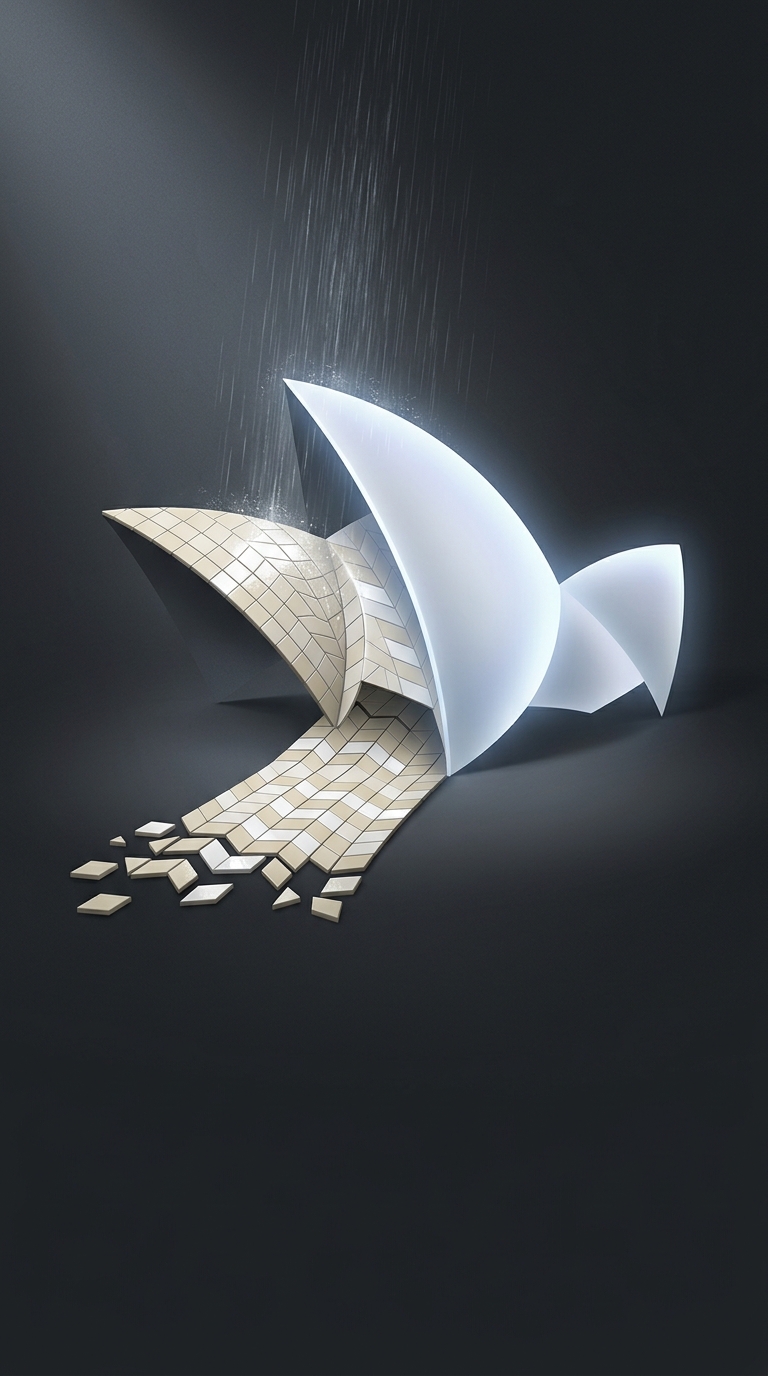
The Opera House’s roof is not a single smooth canopy. Its sweeping forms are built from curved concrete shells, and the ceramic tiles give those shells a durable outer skin. Their interlocking arrangement lets the covering follow the roof’s changing curves without relying on one enormous, custom-shaped sheet.
The tiles’ self-cleaning effect comes from a simple partnership between surface and weather. Their glazed finish is less likely to hold onto loose dust than a rough, porous surface, so rain can rinse much of that dust away as it runs over the roof. The design helps the building stay presentable between maintenance visits; it does not mean every kind of stain disappears in a shower.
Why the roof has two kinds of white
Look closely and the surface is not uniformly bright. Glossy white tiles sit alongside matte cream ones in a chevron pattern. The contrast gives the roof texture and variation, so its large surfaces do not read as a flat, blank white mass. Sunlight shifts across the different finishes, making the curves easier to see from a distance and more intricate up close.
That detail matters because the roof is both the building’s most recognizable feature and an enormous exposed surface. The tile system had to do more than complete its sculptural shape: it also had to endure the elements while letting rain do some of the everyday cleaning.The striking pattern is therefore part of a practical covering, not decoration applied after the engineering was finished.