The “sails” were an engineering problem in disguise
From the harbor, the Opera House’s roof looks like a set of elegant sails. To its designers and builders, those curves were also a difficult structural puzzle: a striking shape had to be turned into pieces that could actually be calculated, made, and assembled. The solution was to derive the roof sections from a common spherical geometry, allowing them to be built from repeated concrete ribs rather than as a collection of unrelated curves.
That decision made the design more workable, but it did not make construction straightforward. The roof’s supporting structure had to be resolved before the interior spaces beneath it could be completed. The building’s eventual form was therefore shaped not only by architectural vision but by the practical limits of engineering and construction at the time.
A roof made to meet the weather
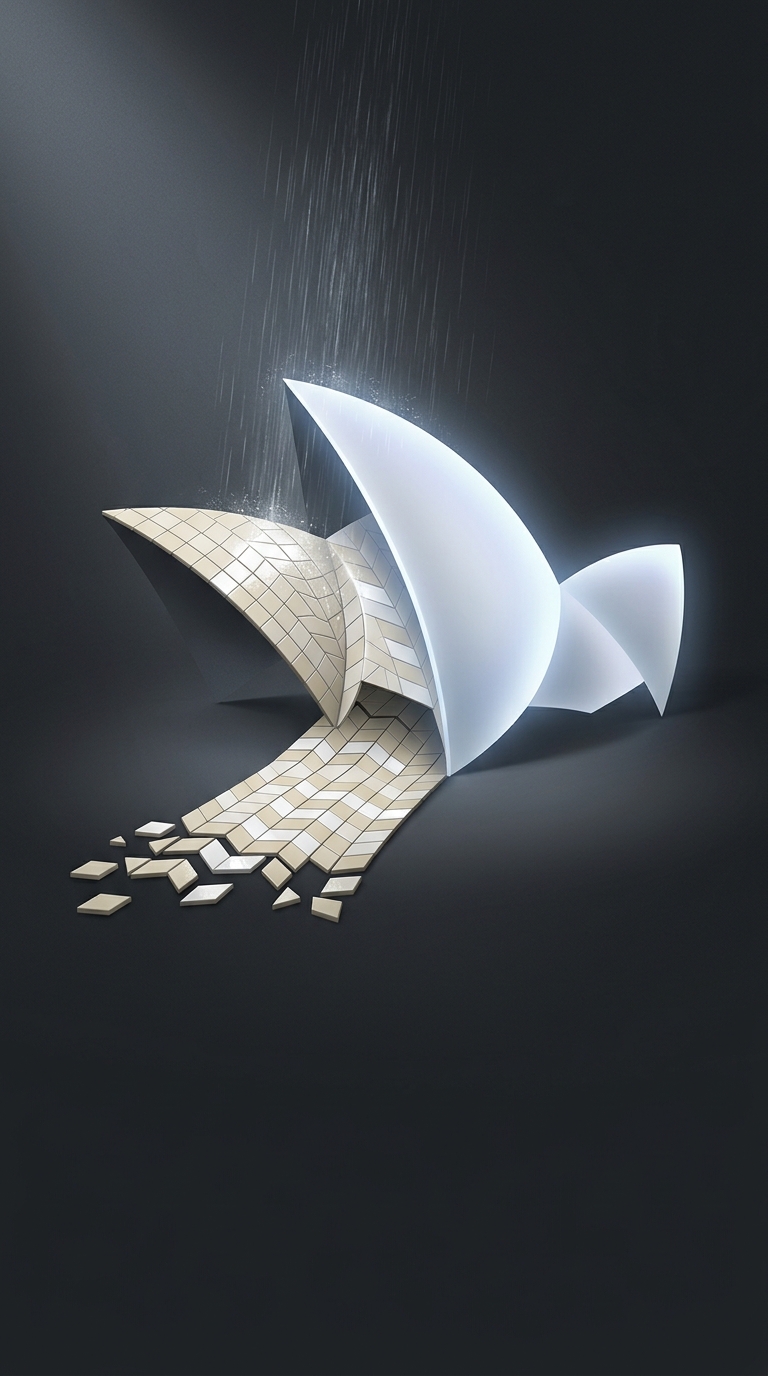
The pale roof is clad in more than a million ceramic tiles. Their glazed surfaces help shed dirt and rain, giving the roof a self-cleaning quality. The tiles are not identical in appearance: their subtle variation in sheen helps the huge curved surfaces respond to changing daylight rather than reading as one flat, uniform white.
This is part of why the building can look different from the water, the forecourt, or a nearby street. The roof is not just a sculptural outline; its material and geometry make light and weather visible across the structure.
The room inside had a different challenge
The exterior’s dramatic curves did not guarantee good sound in the Concert Hall. Acoustics depend on how sound reflects around a room, and the hall’s original design did not provide the musical clarity performers and listeners needed. For decades, the building’s most famous interior was also one of its most discussed shortcomings. Later improvements addressed the hall as a working performance space, not merely as an architectural landmark.
The contrast is a useful way to understand the Opera House: its celebrated appearance came from solving one set of problems, while making the rooms beneath that roof work well required another.