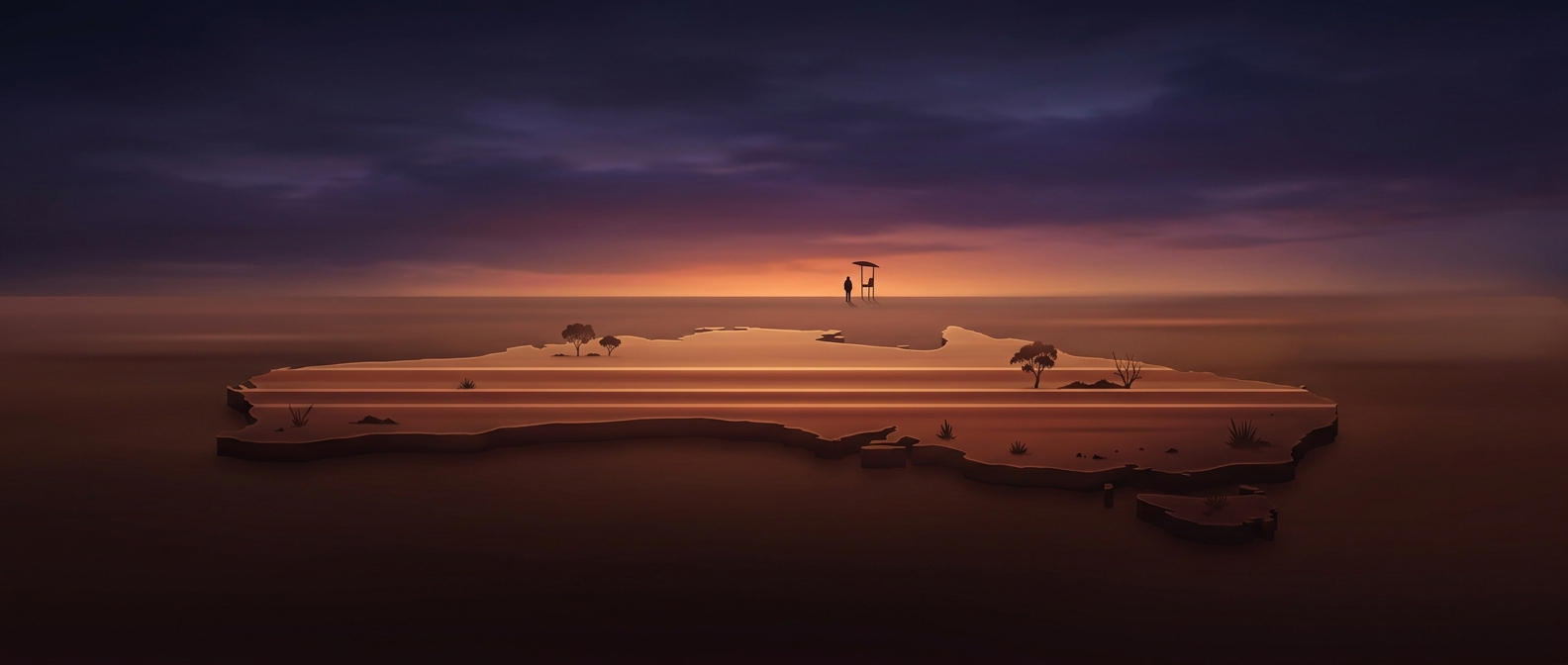
Why Australia’s Ancient Interior Stays Low
“Flattest” does not mean every part of Australia is level. The continent has mountain ranges, escarpments and deep valleys. The description refers to its generally low relief: much of the land sits at modest elevations, without the vast, high mountain belts found on continents shaped by recent tectonic collisions.
Australia’s continental interior is geologically old and has been relatively stable for a long time. Where two plates collide, the crust can buckle and rise into mountains. Australia has not experienced that kind of continent-scale uplift in recent geological time. Meanwhile, wind, water and weathering have had millions of years to wear down elevated terrain and carry sediment toward lower ground and the coast.
A Low Profile, Not a Featureless One
The result is a broad interior of plateaus and plains, bordered in places by higher terrain. The Great Dividing Range runs along much of the east, but it is not a towering wall on the scale of the Himalayas or the Andes. Across the continent, old surfaces have been reshaped by erosion, while rivers and occasional heavy rains have carved channels through otherwise wide, open landscapes.
For travelers, that geological history helps explain why long stretches of inland Australia can feel so expansive: the horizon often has little high ground to interrupt it. The country’s flatness is not an absence of geology, but the visible outcome of an old landscape that has had a long time to settle and wear down.