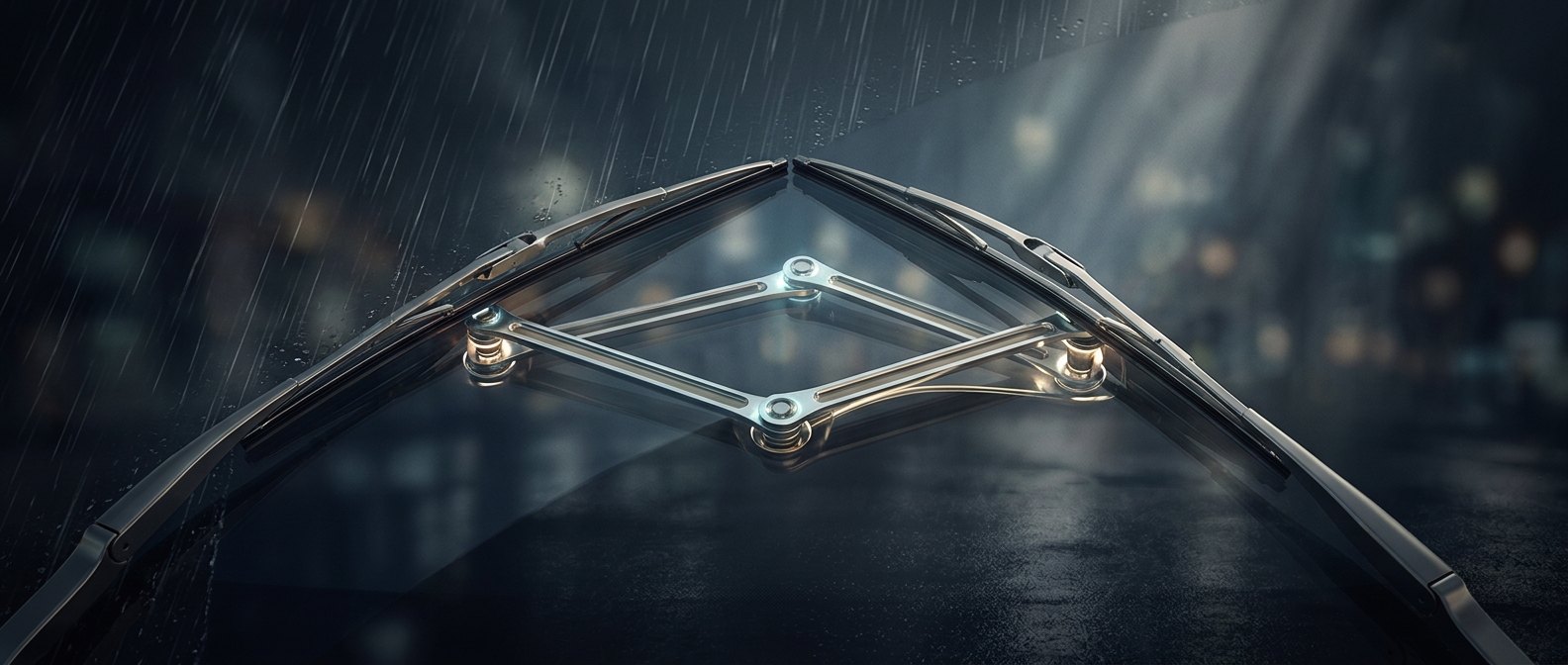
How a rotating motor makes a wiper reverse
The key is that the motor’s shaft is connected to an offset crank rather than directly to the wiper arm. As the shaft turns, the crank pushes and pulls a connecting rod. That rod moves a pivoted output arm, which carries the wiper through its sweep. The crank keeps rotating, but the output arm cannot: its pivot and the rod’s changing angle make it swing back and forth.
Together, the crank, connecting rod, output arm, and fixed distance between their pivots form a four-bar linkage. The geometry does more than change the kind of motion. The lengths and pivot positions determine how far the blade travels and where it reverses, so the mechanism can be tuned to clear a useful area of glass without sending the blade off the windshield.
Why the geometry matters on a windshield
A wiper blade needs to follow a broad arc while staying in contact with glass that curves and slopes. The linkage sets the arm’s motion, while the blade’s flexible construction helps it press along the windshield. If a car has two wipers, the arrangement must also coordinate their paths so they cover much of the driver’s view without colliding.
At each end of the sweep, the linkage changes direction even though the motor continues turning. That reversal is what lets a compact, continuously spinning motor produce the repeated clearing motion—and return the blades to their parked position when the system is switched off.