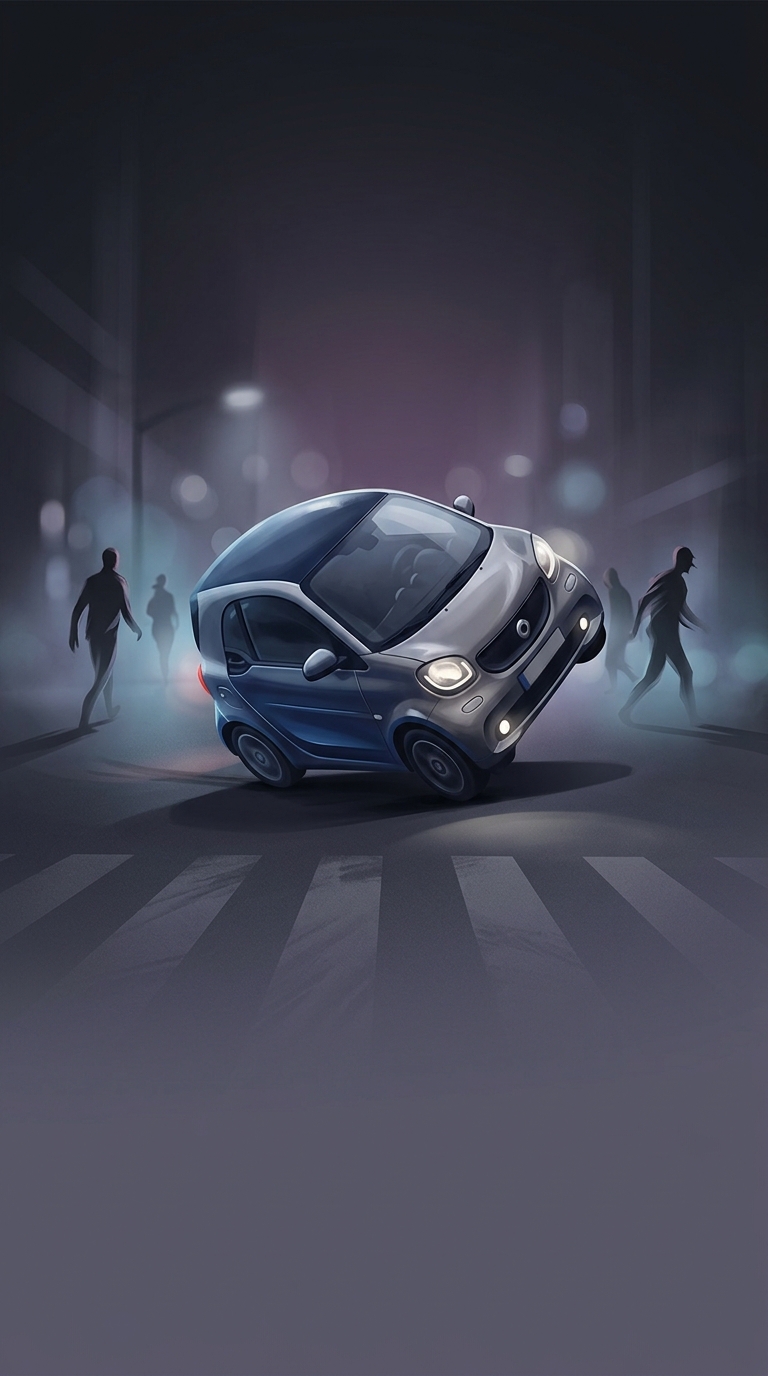
Why a Tiny Car Was Easy to Tip
The Smart Fortwo was built for dense city streets: at roughly eight feet long, it could fit into parking spaces too short for an ordinary car. That compact footprint also made it unusually vulnerable to a particular kind of vandalism. With several people lifting at once, they could raise one end and roll the car onto its side or roof—something that would be far harder with a heavier sedan.
The episode became known locally as “Smart car tipping.” Reports in San Francisco in the early 2010s described small groups overturning parked cars overnight, sometimes leaving them balanced on their sides. The target was not a mechanical weakness in the car so much as a mismatch between its low weight and the leverage a group could apply.
The Engineering Tradeoff
A car’s mass is distributed across its frame, wheels, and components. When people lift an edge, they create leverage around the tires on the opposite side. If enough force is applied together, the car’s center of mass—the point around which its weight balances—can move beyond its support, and gravity completes the roll.
The Fortwo’s safety design addressed crashes, not deliberate group lifting. Its sturdy passenger cell and crash-absorbing structure were meant to protect occupants in collisions; they did not make the parked vehicle impossible to overturn. Compactness and low weight helped the car maneuver and park in crowded neighborhoods, but also made it a conspicuous, movable target.
A Costly Prank in a Crowded City
Once tipped, a car could suffer damage to its roof, windows, mirrors, or body panels, even if it had not been struck by another vehicle. Owners also faced the immediate problem of retrieving a car left awkwardly on its side, while narrow streets and limited parking made the disruption especially visible.
The incident exposed a literal downside of designing for tight urban space: a vehicle small enough to fit almost anywhere could also be small enough for a handful of people to move by hand.