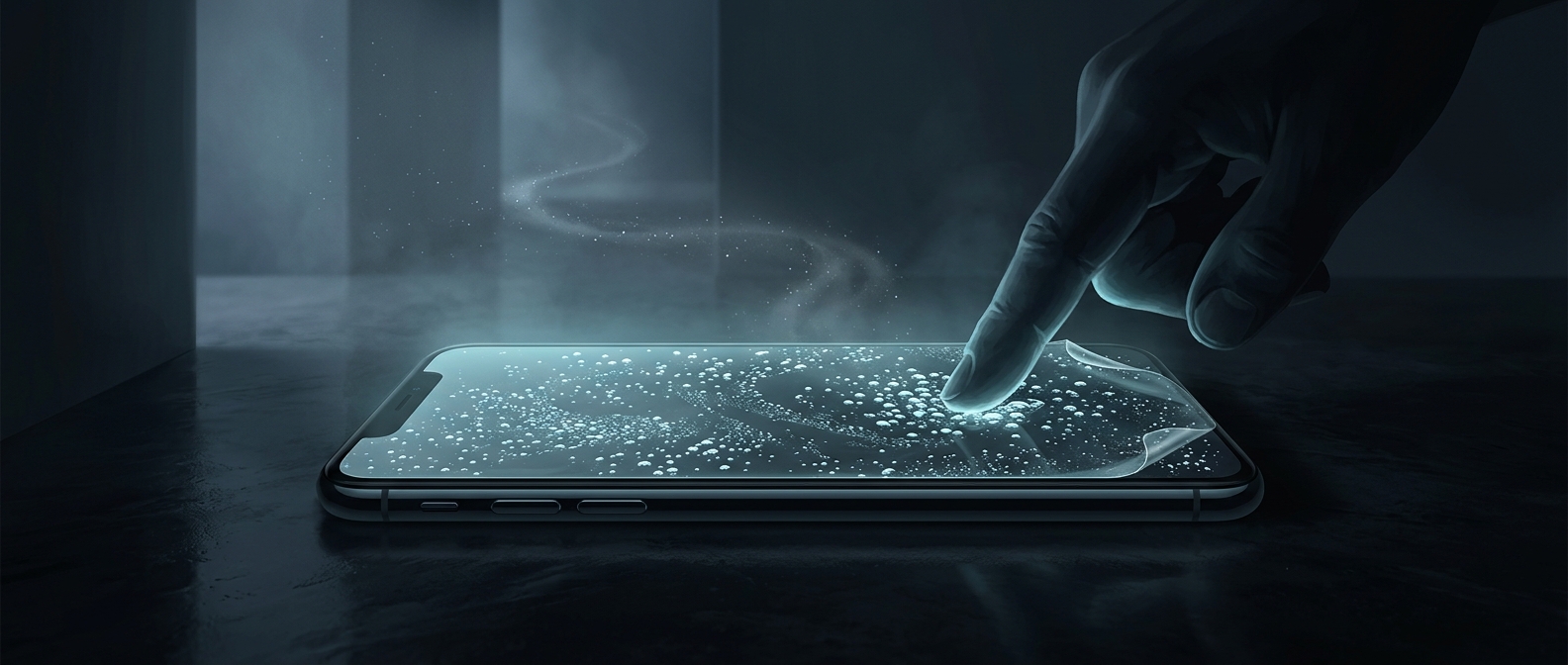
Why a bubble can get stuck under a screen protector
A screen protector does not usually bond to the display like a liquid that fills every gap. Its adhesive makes contact as the protector is pressed down. If the edges of an air pocket seal first, the surrounding adhesive can leave the air enclosed, with no open route to the edge.
That is why pressing harder does not always help. Pressure can flatten a bubble temporarily, but if the air cannot travel through the adhesive-contact area and escape, it may spread back into a pocket when the pressure is released. The bubble is not being held in place by a mysterious force; it is simply trapped beneath a surface that has already sealed around it.
The difference between trapped air and dust
A bubble caused by air may shrink or move if it is gently guided toward an unsealed edge. A speck of dust behaves differently: it holds the protector slightly above the glass, creating a small pocket around the particle. The visible spot may look like an air bubble, but pushing it toward the edge will not remove the obstruction.
This is why a clean display and a gradual application matter. Lowering the protector from one side and pressing outward gives air a route to escape before the adhesive closes behind it. Once the perimeter is sealed, even a tiny pocket can be stubborn—not because it is large, but because it has nowhere to go.