An Anchor Holds Position; It Doesn’t Brake a Moving Ship
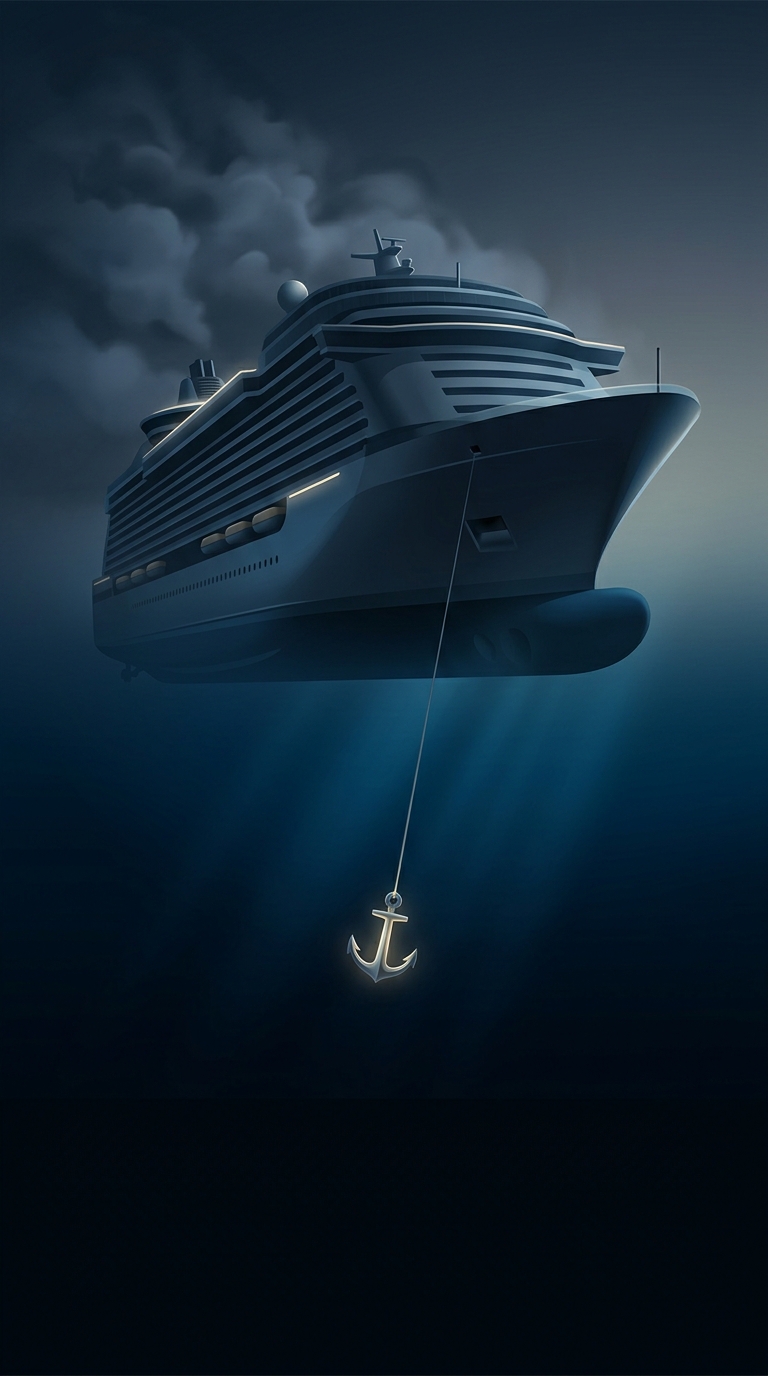
A cruise ship’s anchor is not meant to bring the vessel to a sudden stop. The crew first slows the ship and chooses a suitable anchorage, where the seabed and available water depth can support the hold. The anchor then helps keep the ship from drifting under wind and current.
That distinction resolves the apparent mismatch in scale: the anchor does not have to counter the ship’s full mass as if it were a parked car’s handbrake. It has to resist the forces trying to move a vessel that is already moving slowly or nearly still.
The Chain Does Much of the Work
The anchor is connected to a long, heavy chain. When enough chain is paid out, its weight makes part of it rest along the seabed, while the section leading to the ship curves downward. This curve is called a catenary. It helps keep the pull on the anchor low and nearly horizontal rather than lifting it up and out of the bottom.
That direction matters. An anchor’s broad flukes—the pointed, shovel-like parts—are designed to bite into suitable seabed when pulled along it. As wind or current tugs the ship, tension passes through the chain to the buried anchor. The more securely the flukes dig in, the harder the vessel is to drag across the bottom.
A Hold Depends on the Whole Setup
The anchor’s effectiveness depends on more than its own size. The crew must pay out enough chain for the water depth and conditions, and the bottom must be appropriate for the anchor to grip. Wind, current, and the ship’s exposed profile all affect how much force the anchoring system must withstand. If conditions change, the ship may need to reposition or leave rather than rely on the anchor indefinitely.
So the striking sight of a small anchor holding a giant ship is really a system at work: a slowed vessel, a heavy chain that manages the direction of force, and flukes that use the seabed as a grip. The anchor does not overpower the ocean; it gives the ship a way to resist drifting while conditions remain within the system’s limits.