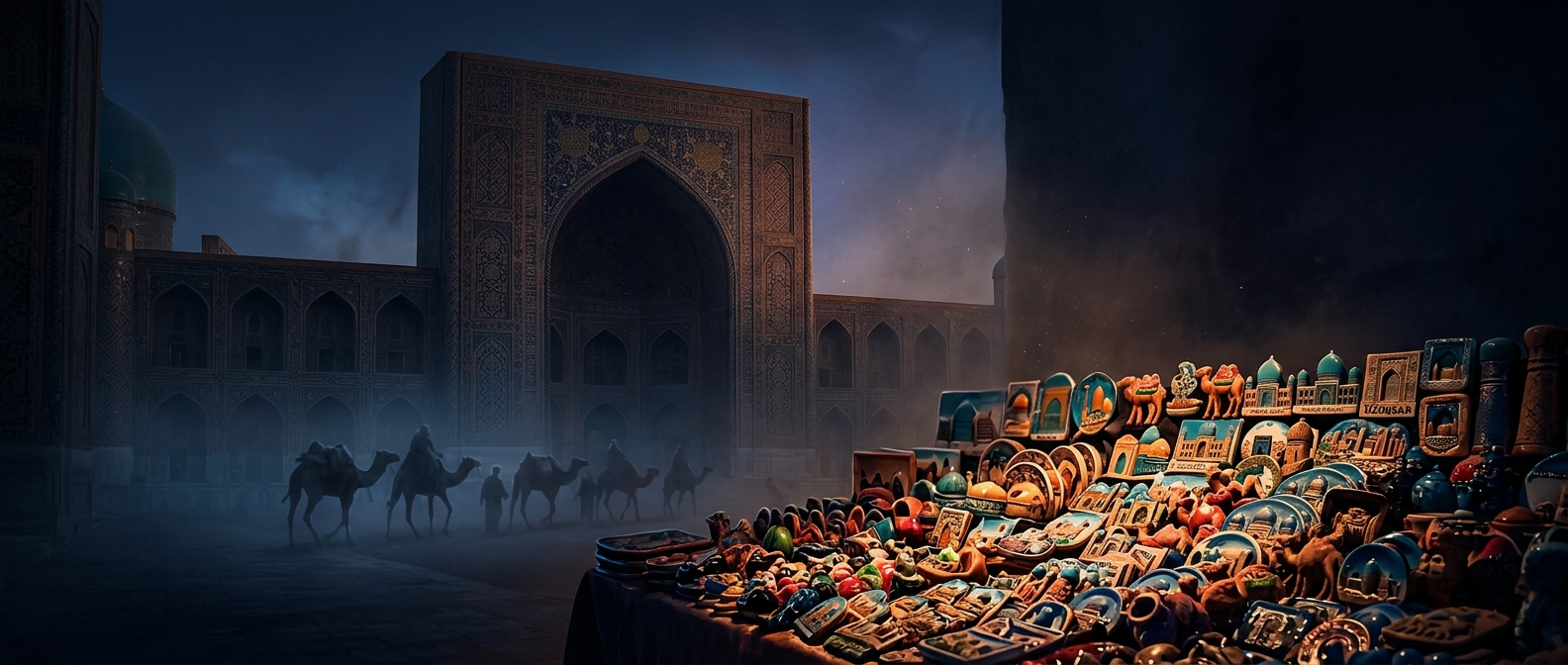
A square built for learning and public life
Registan was not simply a market surrounded by grand buildings. Its name means “sandy place,” and the square became the civic heart of Samarkand, where people gathered amid the city’s religious, educational, and commercial life. The madrasas—Islamic schools where students studied subjects including theology and law—gave the square a scholarly purpose as well as a monumental one.
That setting connected learning with movement. Samarkand stood within the network of trade routes now called the Silk Road, along which merchants carried goods between regions. The square’s busy city life made it a natural place to encounter travelers, traders, and local residents, though the madrasas themselves were schools, not merchant inns.
From working center to historic landmark
Registan’s role changed as Samarkand changed. Trade routes and political centers shifted over the centuries, while the institutions that had made the square a living center of city life no longer served their original functions in the same way. Its buildings endured, but their use increasingly became cultural and historic rather than everyday commercial and educational.
Today, visitors come to read the square through its architecture: towering entrance portals, richly patterned tile, and courtyards that reveal how the schools were arranged. Souvenir stalls add a small-scale commercial life, but tourism now shapes the encounter more than long-distance trade does. The striking change is that Registan’s buildings have outlasted the systems that animated them—and now the architecture itself is what draws people from far away.