Why a shallow metal cone pushes back
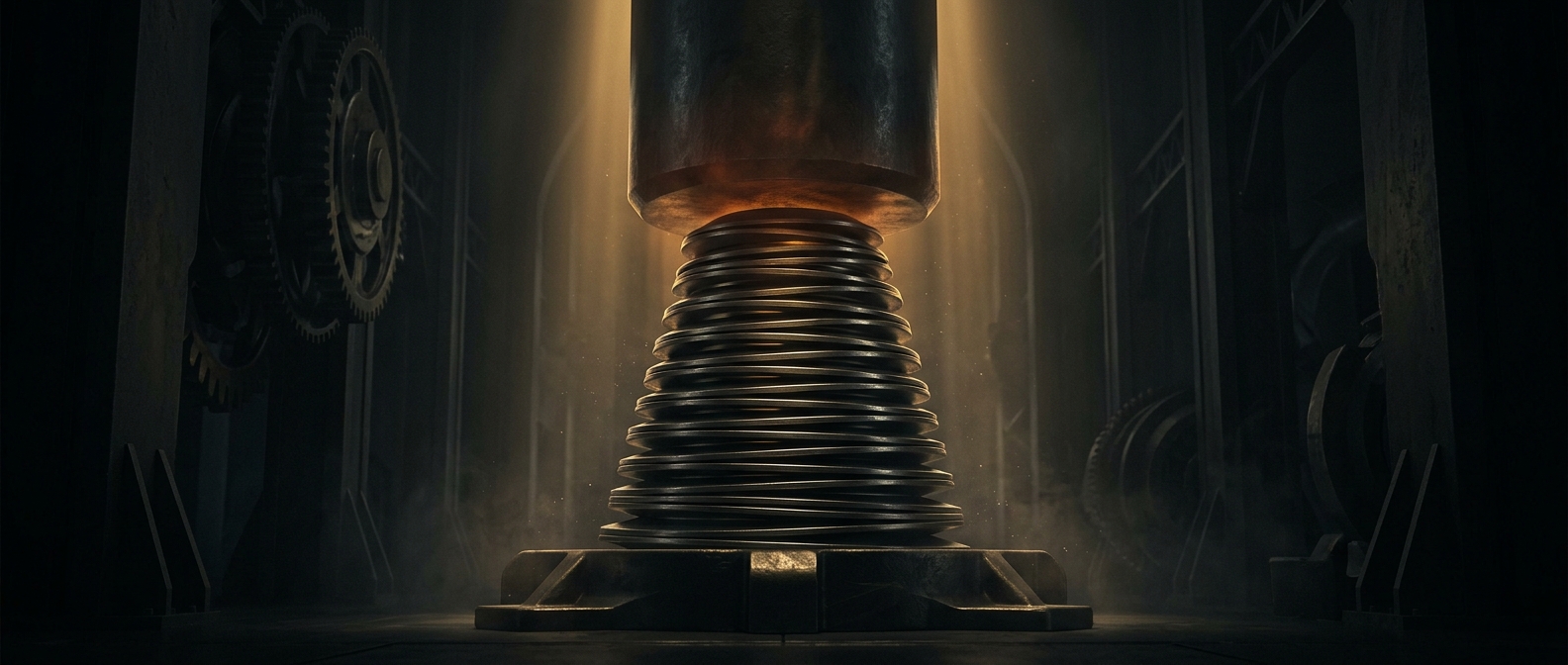
A Belleville washer is a ring of spring steel formed into a shallow cone. When a bolt or other load presses on it, the cone bends toward flat. That deformation stores elastic energy in the metal; as the load eases, the washer pushes back toward its original shape.
Unlike a coil spring, which needs room for its loops to compress, a Belleville washer works within a thin, disk-shaped space. Its force depends on its dimensions, material, and how far it is deflected. Near flat, its response can become strongly nonlinear: a small additional movement may require a markedly different force than it did earlier in the stroke.
Stacking changes the spring
Designers can stack washers in the same orientation or alternate their directions. Nested in the same direction, they act roughly like one thicker spring, increasing the force they can provide over a similar movement. Alternated, they behave more like springs arranged in series: the stack can move farther under load, while the force is closer to that of one washer. Combinations let engineers trade travel for force without adding a long coil spring.
That compact adjustability is useful where space is tight and a joint must keep pressure as parts settle or shift slightly. The washers still need to stay within their intended deflection; flattening them too far can permanently deform the metal and reduce their spring action. A small stack can therefore serve not just as a spacer, but as a carefully chosen reserve of force inside a bolted connection.