A gear set hidden between the wheels
Most cars send engine power to a differential: a compact gear assembly mounted between the driven wheels. The driveshaft turns a housing inside it, and gears in that housing pass power to each axle. The key is that the two axle gears are not rigidly locked together. Small bevel gears, often called spider gears, can rotate between them and let one axle turn faster than the other.
What changes when the car turns
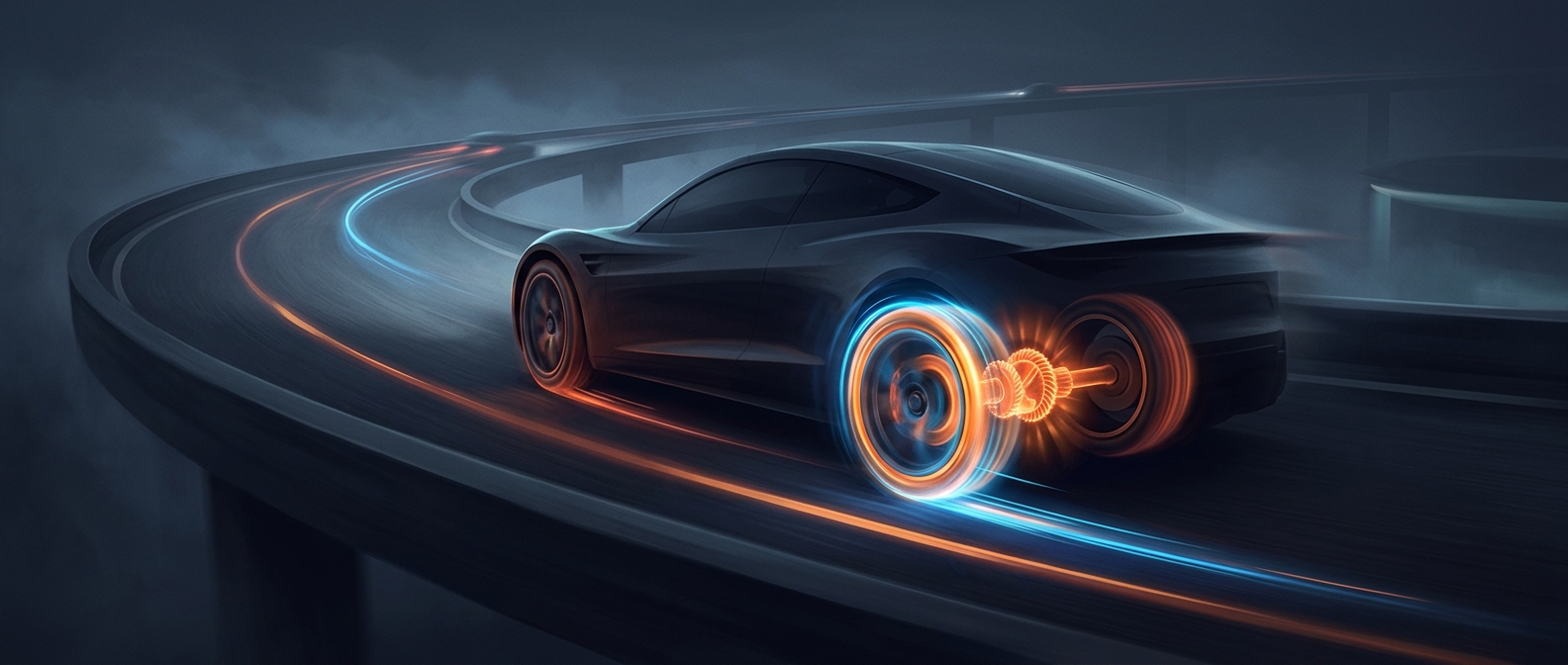
On a straight road, both wheels cover nearly the same distance, so the differential’s gears carry them along at roughly the same speed. In a turn, the outside wheel follows a wider arc. As it travels farther, the small gears inside the differential rotate and allow that wheel to speed up relative to the inside one, while both remain connected to the engine.
Without that freedom, the wheels would be forced to rotate at matching speeds even though their paths demand different ones. The tires would have to flex or slide against the pavement, creating scrub and extra wear—and making the car less smooth through the turn.
A useful compromise
A conventional open differential can distribute power while allowing different wheel speeds, but it has a tradeoff: if one wheel loses traction, it may spin while the other receives little usable drive. Some vehicles use limited-slip or locking designs to reduce that problem. The basic differential’s cleverness is simpler: it lets the two wheels disagree about speed without disconnecting either one from the engine.