A ring folds a long accelerator into a compact path
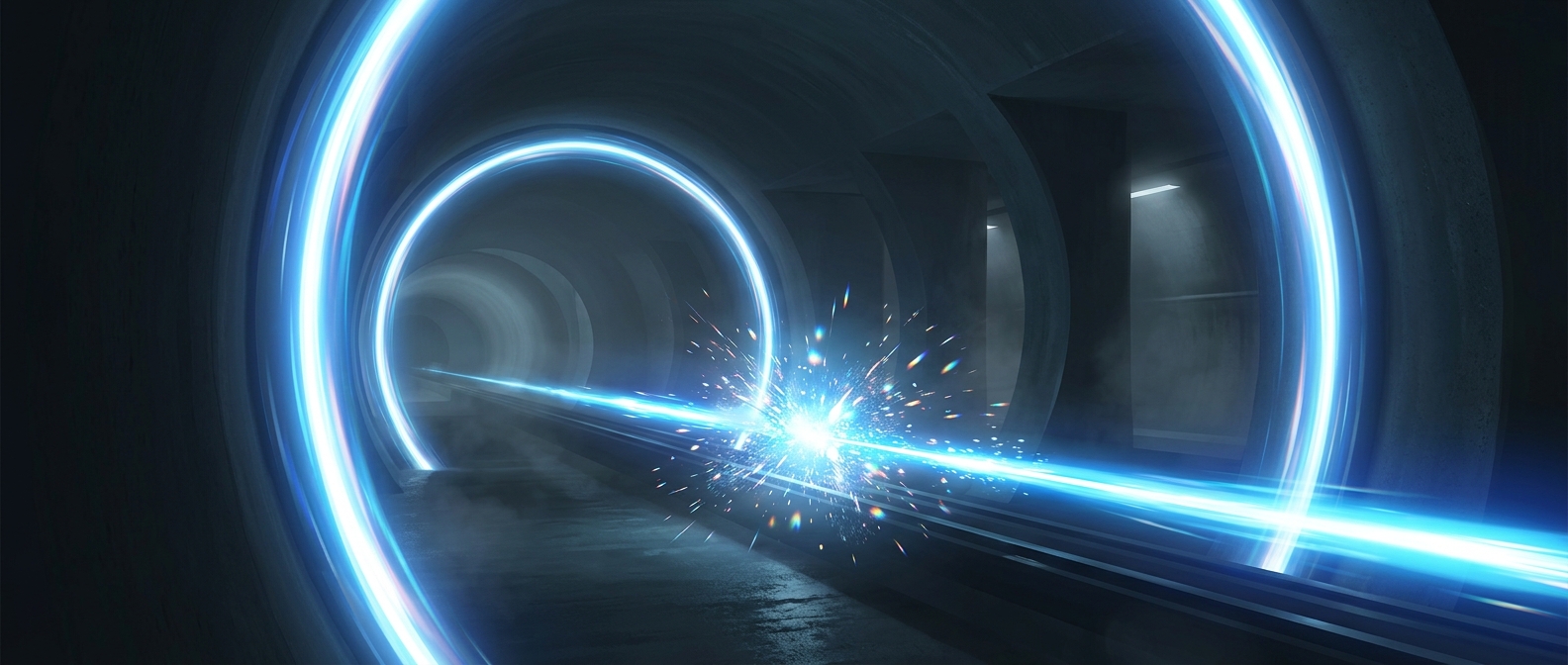
A particle accelerator does not simply fire matter down an empty tunnel. Its ring uses carefully controlled magnetic fields to bend particle beams around the track and keep them focused. Radio-frequency cavities—metal chambers that create timed electric fields—give the particles repeated pushes as they pass, letting them gain energy over many laps.
The circular route makes it possible to build up energy without constructing one straight machine of comparable length. It also lets beams circulate until they are brought into collision at designated points.
The collision is only the beginning
When particles meet, their energy can produce new particles, some of them extremely short-lived. Those particles may decay almost immediately into others. Layers of detectors surrounding the collision point record the paths and energies of the resulting spray, rather than offering a direct photograph of the original event.
Scientists use those measurements to work backward: a particle’s track can reveal its electric charge, while the energy carried away by detected particles helps reconstruct what was produced. A particle that disappears too quickly to register may still leave a distinctive pattern in its decay products.
Why the machine needs so much infrastructure
The beams must travel through an exceptionally empty pipe so they do not scatter off stray gas molecules. Magnets must steer them precisely, and the detector systems must sort out the aftermath of collisions that happen amid many other signals. The ring is therefore not just a track for making particles fast; it is also a controlled environment for producing and measuring events that cannot be examined directly.
The practical payoff is that a fleeting subatomic event can leave durable evidence: millions of detector readings from a collision that lasted far less than a blink.