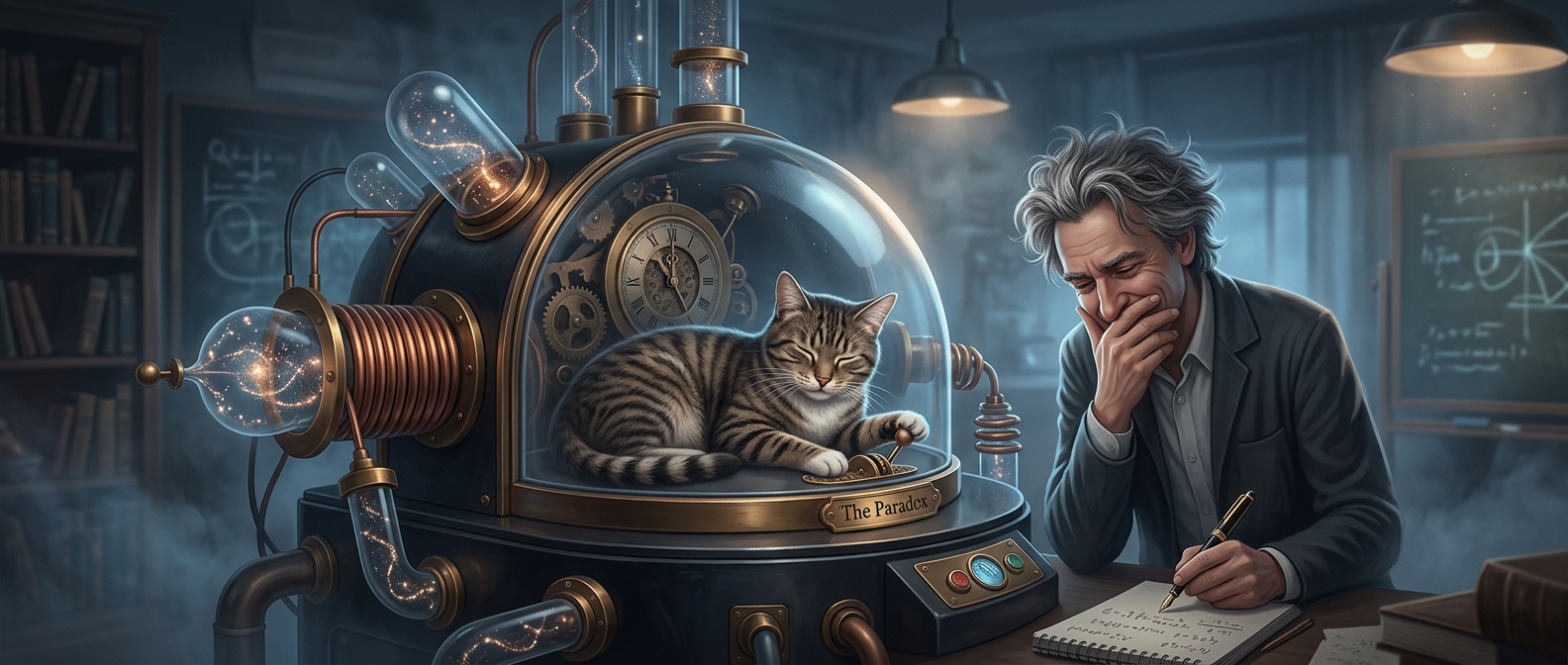
Why Schrödinger Put a Cat in the Box
In 1935, physicist Erwin Schrödinger devised his cat scenario as a challenge to a particular reading of quantum mechanics—not as a proposal for a real experiment. The theory successfully predicts what tiny particles will do, but its mathematical description can combine different possible outcomes before a measurement. The puzzle was what that description meant for the ordinary world.
From an Atomic Event to an Animal’s Fate
In the thought experiment, a single radioactive atom sits beside a detector. If the atom decays within a set time, the detector triggers a mechanism that releases poison; if it does not, the cat remains alive. The atom’s decay is random, so before anyone checks, quantum theory can represent it as a superposition: a combination of the “decayed” and “not decayed” possibilities.
Because the detector links the atom to the poison and the cat, the same mathematical description appears to spread through the chain. Taken literally, it suggests a cat that is both alive and dead until observation. Schrödinger’s deliberately jarring leap from particle to pet exposed how strange that conclusion sounded when applied to familiar objects.
The Point Was the Problem, Not the Cat
The scenario pressed on a gap between two ways of describing nature: quantum equations allow overlapping possibilities, while everyday experience presents definite outcomes. What counts as a measurement, and how a single outcome emerges, became central questions in interpreting the theory. Schrödinger’s example made the tension impossible to ignore without claiming that a household cat could be observed in a stable, ordinary sense as both alive and dead.
The cat’s lasting role is therefore rhetorical as well as scientific: it turns an abstract uncertainty about an atom into a consequence anyone can picture, forcing the question of where quantum descriptions stop matching everyday reality.