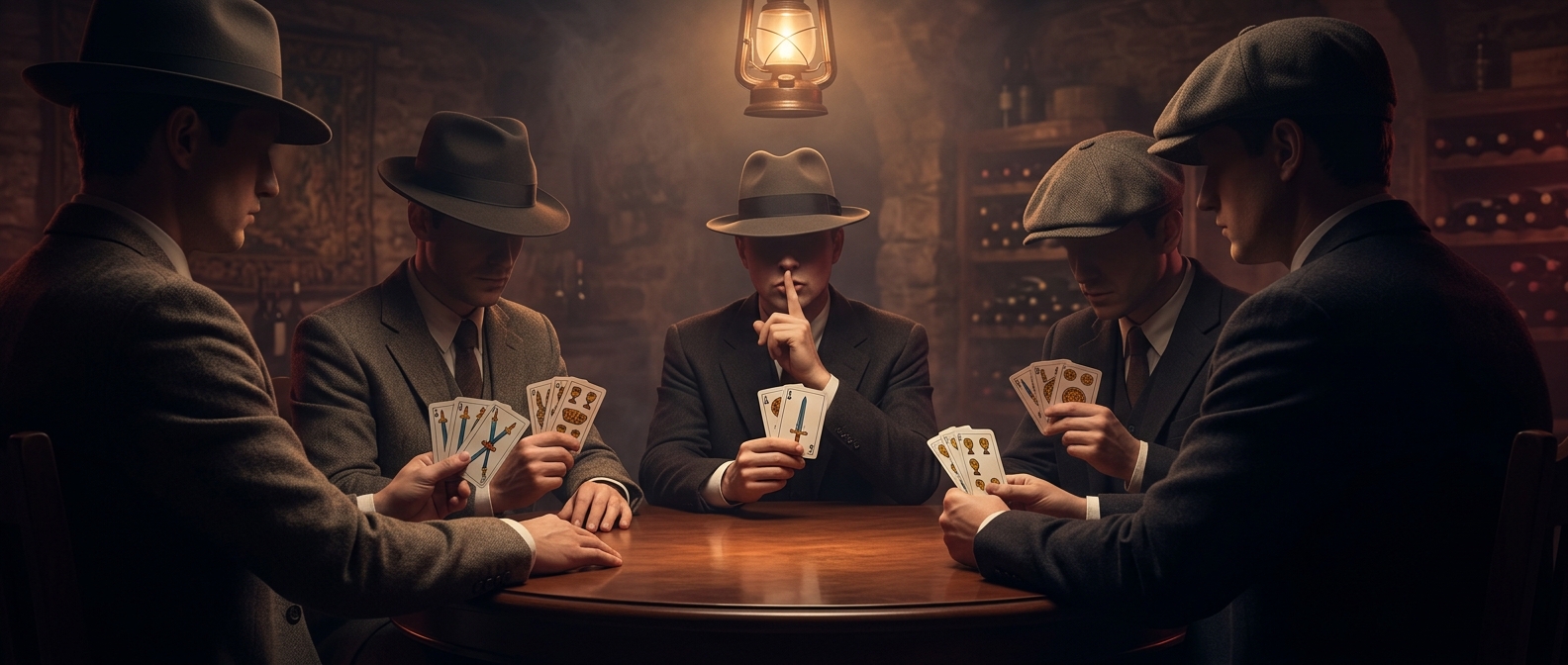
One player must read two opponents at once
Skat deals 10 cards to each of three players and leaves two face down in the middle; those cards are the skat. After bidding, the player who wins the auction becomes the declarer, playing alone against the other two. The defenders share a goal, but they cannot show each other their cards or openly plan their play. Their cooperation has to emerge through the cards they lead and follow.
That makes every trick a small test of attention. A player must track which high cards have appeared, infer what the opponents may still hold, and decide whether a partner’s move is a signal worth trusting.
Bidding sets the stakes before the cards are played
Bidding is not simply a contest to name the strongest hand. Players offer values tied to the game they intend to play. The high bidder takes the declarer’s role and must choose a contract—such as a suit game, in which one suit is trump, or a grand game, in which the jacks are trump. The contract’s value must support the winning bid, or the declarer risks losing the game.
The declarer can usually pick up the two skat cards and discard two cards, improving the hand while choosing what to leave out. Or the declarer can play without picking them up, a more demanding option that can raise the game’s value. Thus the auction helps shape not only who plays alone, but also the risk they accept.
The hidden information keeps all three involved
The declarer tries to win enough card points to fulfill the contract; the defenders try to stop that. Since nobody sees the other hands, a card that looks unimportant may reveal that a suit is exhausted or that a key trump has already been spent. Skat’s three-player tension comes from unequal roles but shared uncertainty: two players must coordinate without speaking, while the lone player tries to understand both of them at once.