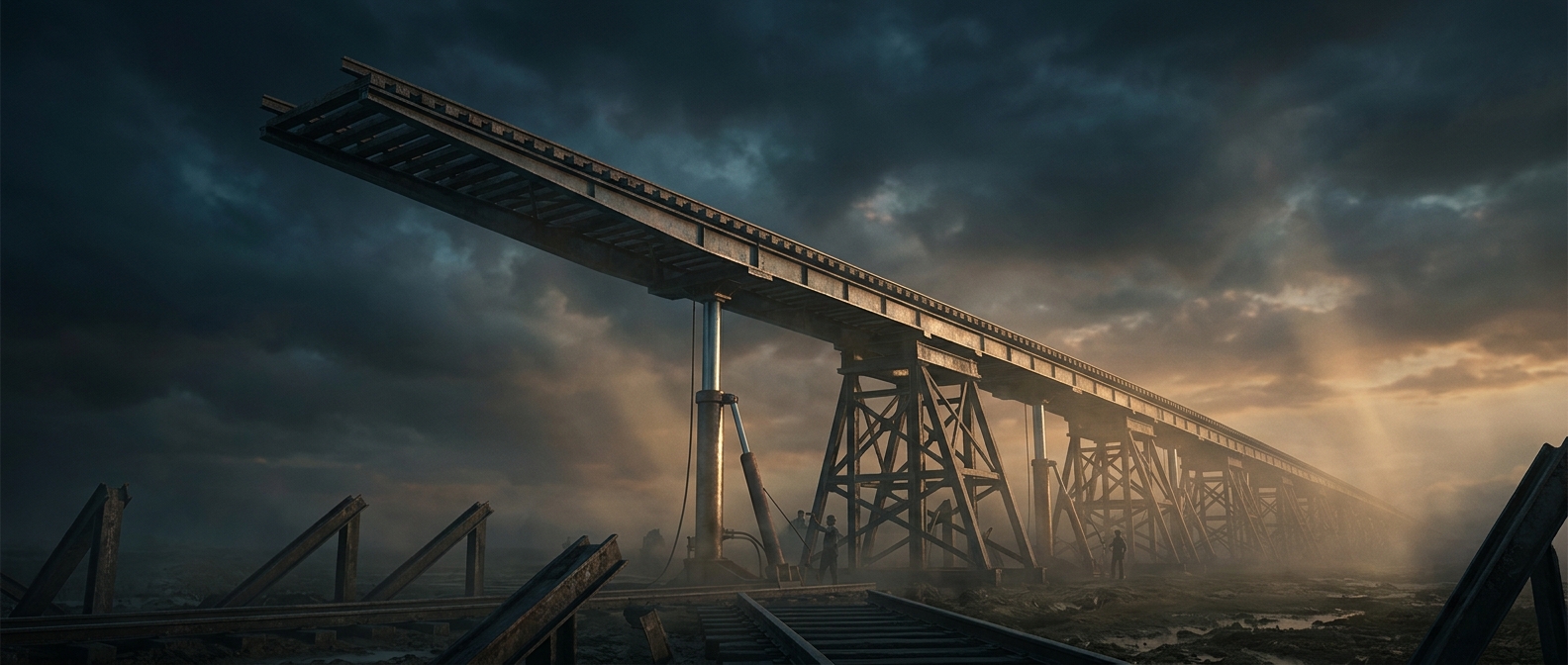
Why an open railway can be safer in a flood
A railway built on a solid raised embankment can act like a dam. During a hurricane, water moving across the landscape may collect on one side, while the embankment blocks drainage and concentrates pressure on the structure. Raising the tracks on bridge-like supports changes that interaction: water has room to flow beneath the line rather than meeting a continuous wall.
That openness matters most when floodwater spreads across a broad, low-lying route. Instead of trying to keep every drop away from the railway, engineers make space for water to pass while keeping the track bed above expected flood levels. The design turns a barrier across the landscape into a crossing over it.
Elevation is only part of the protection
The supports and foundations still have to withstand fast-moving water, floating debris and erosion around their bases—a process called scour. Tracks, signals and power equipment also need protection; a rail line can be above the water and still be disrupted if its systems are not.
There is a practical tradeoff, too. Elevated construction requires substantial foundations and carefully planned connections to stations and streets. But where storms can spread floodwater across a route, leaving room for that water to move can reduce the risk that the railway itself will worsen flooding nearby. The key is not simply to lift the rails, but to avoid making the raised line a wall in the water’s path.