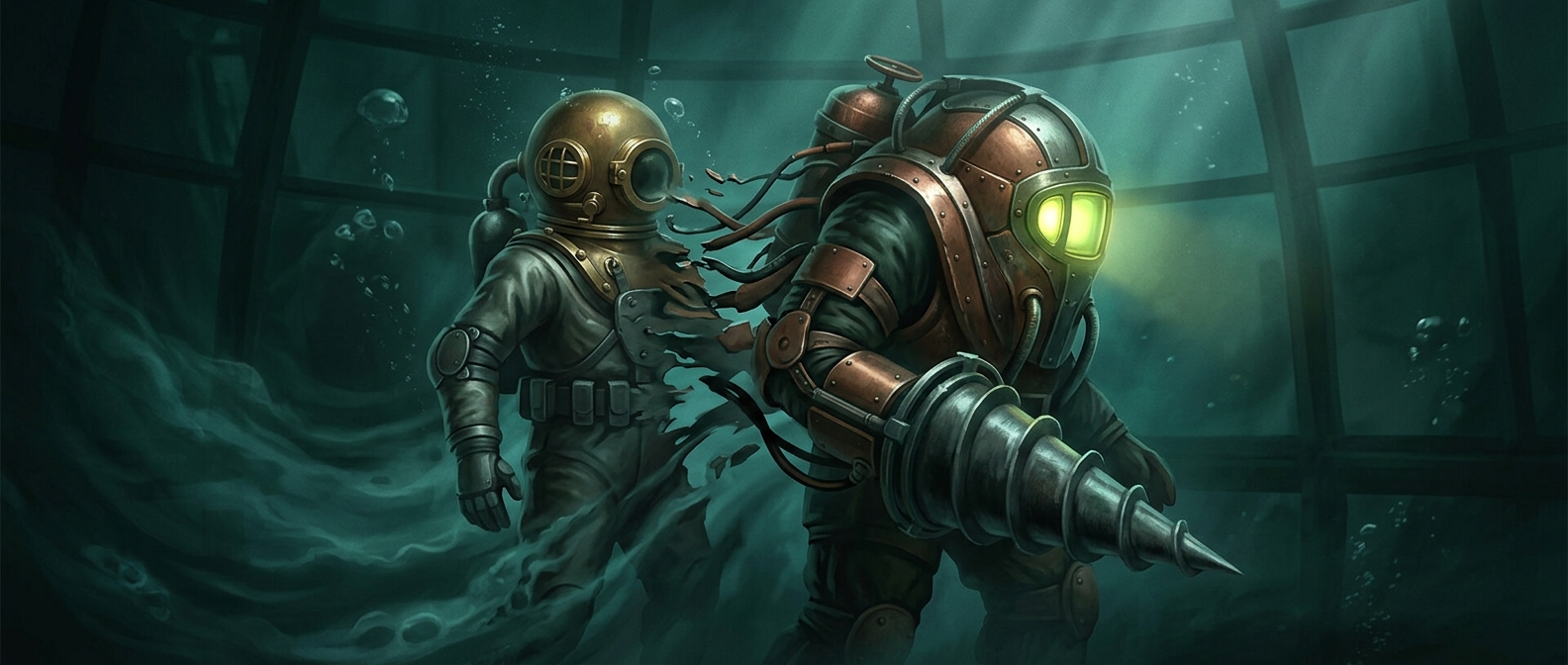
From deep-sea equipment to a game-world silhouette
The Carmagnolle diving suit offered a striking starting point: a human-shaped shell built to keep a diver alive underwater. Its many small viewing windows and rigid, jointed construction made it look less like ordinary clothing than a walking machine. That visual language suited BioShock’s underwater setting, where people and equipment are constantly made to contend with pressure and isolation.
Why exaggerate the reference?
The developers pushed the suit’s brass appearance into a heavier, more threatening shape, then added a glowing visor and a drill. Those changes did more than make the design memorable. The lit face gives the player a visible point to track, while the drill makes the danger legible before the Big Daddy ever attacks: this is a close-range threat built around force.
The result also preserves a trace of the original diving gear’s purpose. Both designs conceal a vulnerable person inside an imposing shell. But the game turns that practical enclosure into a character silhouette—one that can read as both protective equipment and a warning.
A design that tells you what to expect
In a game, a memorable shape has to work at a glance. The Big Daddy’s oversized suit, bright visor, and unmistakable drill distinguish it from the surrounding machinery and signal that an encounter will be different from fighting an ordinary enemy. A real diving suit helped supply the visual foundation; exaggeration made that foundation readable as a threat.